Olivine fabric and microstructure in Northwest Africa (NWA) 7059 and Nova 018: Insights into ureilite deformationOPEN ACCESS
A. I. Sheen, C. K. F. Tirona, K. T. Tait, L. F. White, B. C. Hyde, S. Korchinos
MAPS, Version of Record online: 22 August 2025
LINK (OPEN ACCESS)
PDF (OPEN ACCESS)
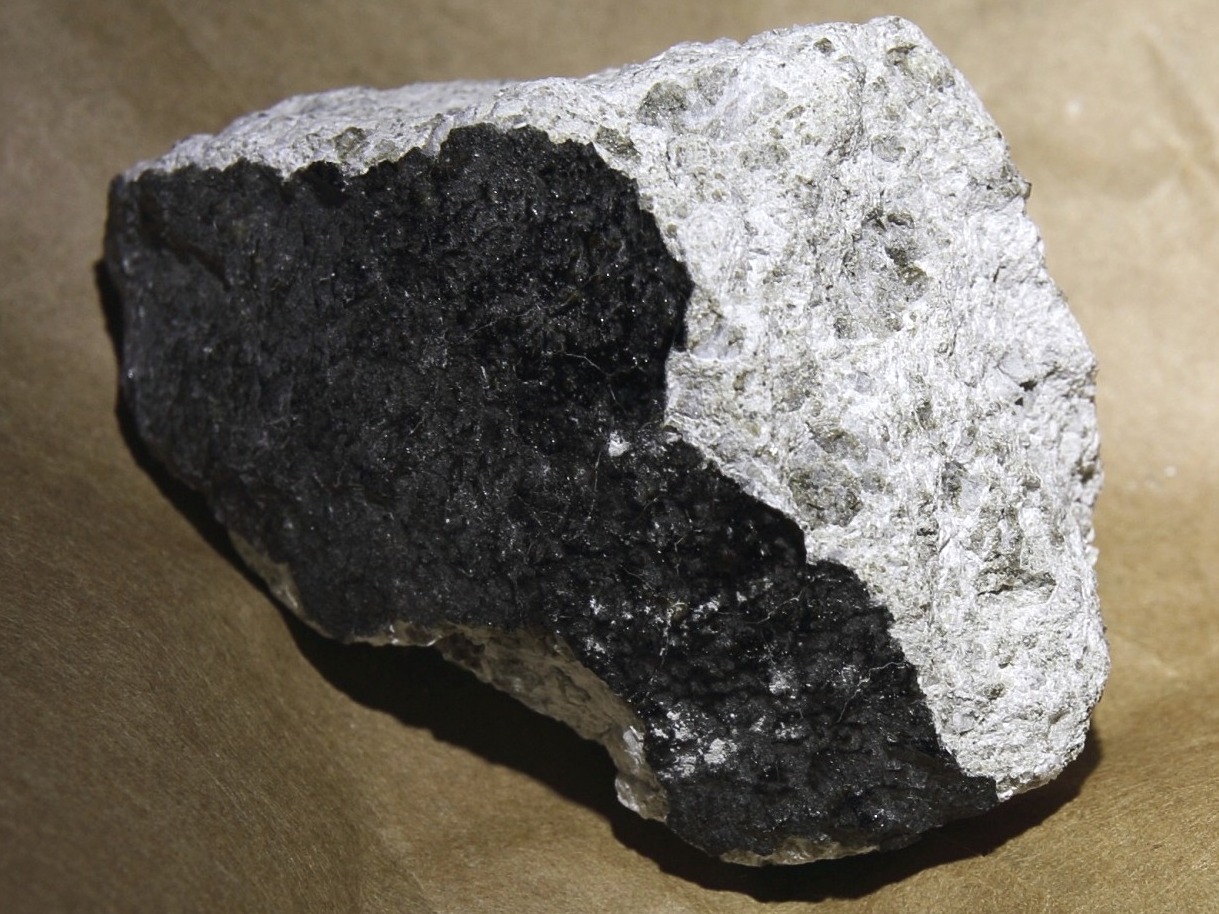
“Olivine is a major constituent in ureilites and commonly defines macroscopic fabric via shape-preferred orientation of elongate grains. In this study, we examined olivine fabric (crystallographic preferred orientation, or CPO) and microstructures in the unbrecciated olivine-pigeonite ureilites Northwest Africa (NWA) 7059 and Nova 018 using electron backscatter diffraction (EBSD) analysis. Point-per-grain orientation data of NWA 7059 indicate a <010> lineation subparallel to grain elongation. Misorientation data of two grains in NWA 7059 indicate dominant activity of (010) [100], (001) [100], (100) [001], and {hk0} [001] slip systems. Nova 018 displays an axial-[010] fabric, with misorientations indicating (010) [001], {hk0} [001] slips, and formation of (010) twist boundaries. Axial-[010] fabric in Nova 018 is consistent with compaction of residual olivine during melt extraction. The <010> lineation in NWA 7059 is unlike typical ureilite fabric and requires a [010] Burgers vector, uncommon in terrestrial samples. Rotational axis analysis of 2°–10° misorientations in olivine shows that the relative proportion of [001] slips and [100] slips in both ureilites are similar to warm-shocked ordinary chondrites, which were deformed at subsolidus temperatures. However, subsolidus deformation temperatures for both studied ureilites are inconsistent with a “hot disruption” model for the ureilite parent body (UPB). The further lack of correlation between 2°–10° misorientation metrics and olivine core Fo content argues against deformation temperature as the main control on olivine slip systems in ureilites. Our findings highlight the use of olivine petrofabric to gain insights into ureilite deformation, as well as complexities in interpreting olivine deformation data with respect to the history of the UPB.”