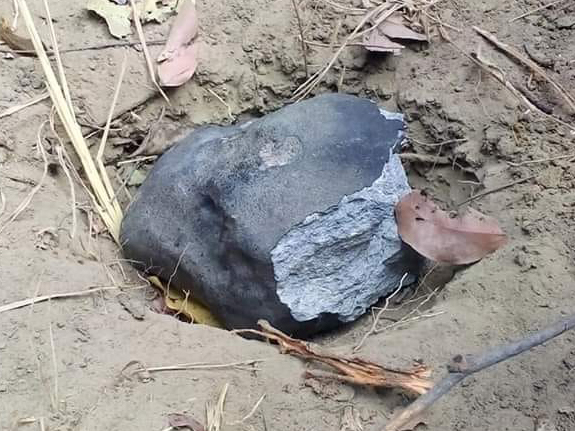
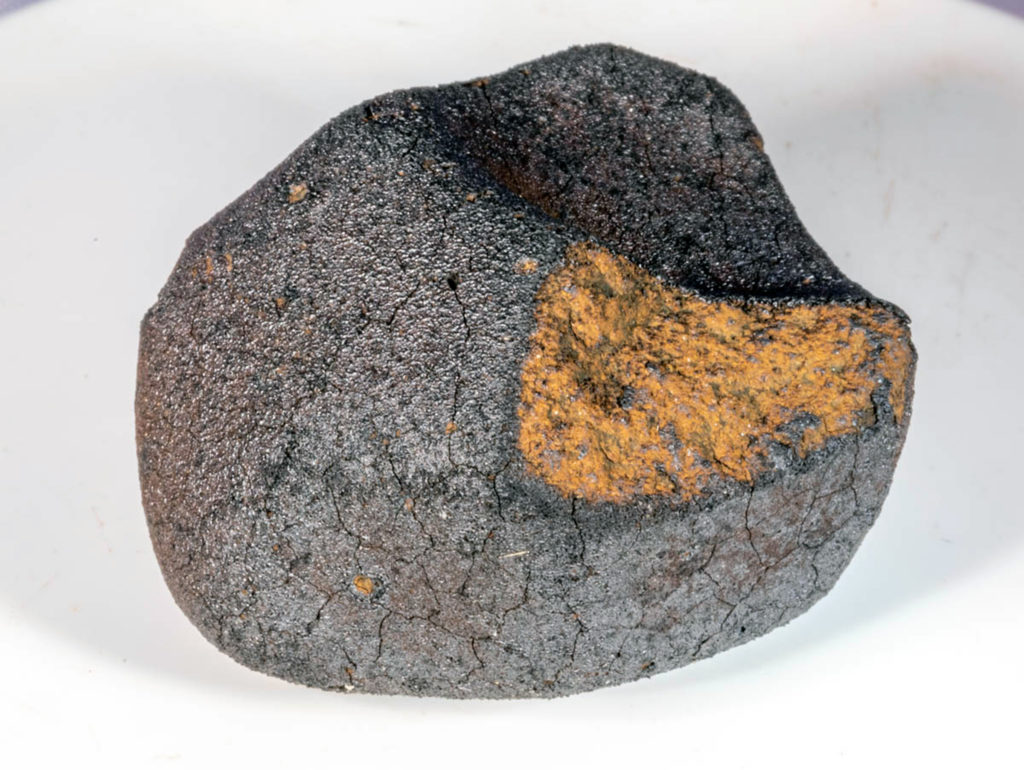
OKULOVKA / Окуловка meteorite fall (~528 g in fragments, LL6, S2) in Okulovka (Окуловка), Novgorod region, Russia at 3:32:13-3:32:44 UTC on 27 October 2025
Last update: 16 April (19:00 CEST)
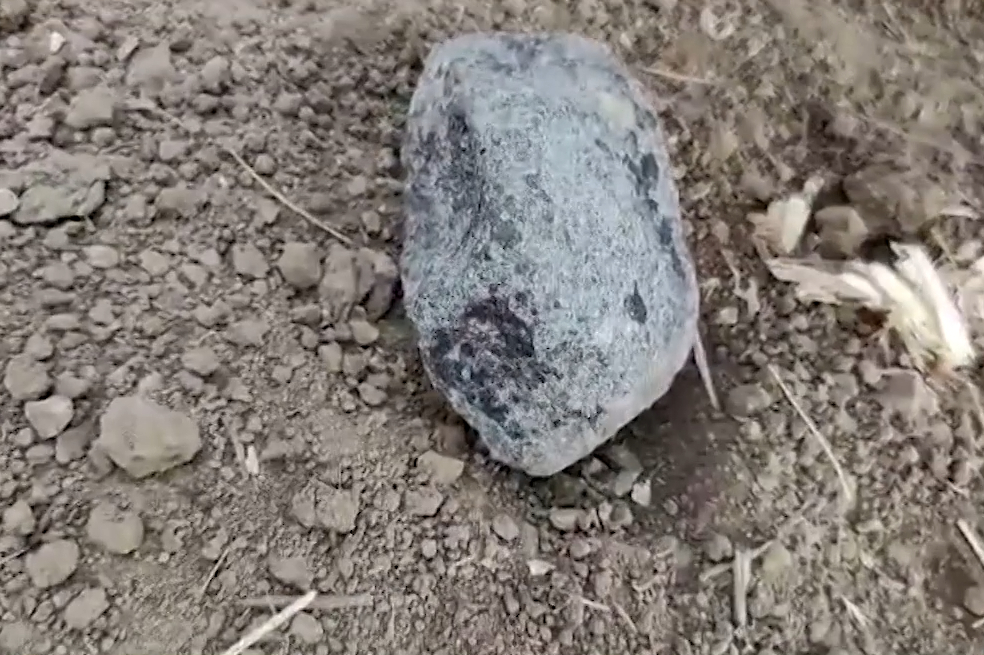
On 8 November 2025 the first ad of a found meteorite was published on the Russian classified ad website Avito. One meteorite mass (~413-500 g) shattered a flat red tin rooftop in eastern Okulovka (Окуловка), fragmented into several pieces (144 g, 52 g, 32 g, 45 g, 83 g, 63 g and many smaller ones which had remained inside the broken wooden roof after the discovery of the hole and were all removed later when the roof was cut). The home owners were reportedly awake at the time of the fall and heard a loud crash but thought it was the neighbors. Later that day they found some crumbs and fine dust in the yard next to the roof but thought that children had played there and had spilled some concrete dust. The ~10-centimetre hole in the roof was probably discovered on 29 October. It was reportedly discovered by accident that day when the home owner for the first time noticed some kind of stain on the roof and then climbed up to have a look. He first thought that a bird had dropped a rock on their roof. The meteorite fragments from the hole in the roof partly broke into smaller pieces when the home owners removed them. Other smaller meteorite fragments were found in the yard. Until the discovery of the hole with the meteorite in the roof the home owners had not heard anything about a bolide or meteorite fall in the area. Only then they became aware of relevant media reports. The meteorite fragments were offered on Avito for less than a day by a woman called Tatyana before the ad was automatically removed by the website for being placed in the wrong category. According to the ad the fall location was in Okulovka. The ad was first seen by Evgeniy Trofimov who contacted the woman and was sent photos. Trofimow enabled scientific research of the meteorite by establishing the first contact between Tatyana and the Vernadsky Institute of Geochemistry and Analytical Chemistry (GEOKHI RAS). The homeowner then apparently gave about a fifth of the found meteorite fragments to GEOKHI RAS for scientific analysis but refuses to talk to media. The first three fragments (7.775 g, 6.192 g and 2.322 g (used for thin section)) of a larger fragment were sent to the Moscow laboratory on 10 November and on 18 November 2025 other fragments were delivered. Ural Federal University (UrFU/УрФУ) received a 33.2-gram fragment for analysis. GEOKHI’s Konstantin Ryazantsev and Dmitry Sadilenko visited the fall site and the fall region. They agreed to purchase the recovered meteorite samples. The roof of the house has already been repaired. The home owners insisted that they wanted to remain anonymous at all costs. An application for a MetBull registration is planned in the near future since the classification analyses are almost finished.
For a proper MetBull registration of any ordinary chondrite as a confirmed fall we usually recommend radioisotope analyses to confirm a very young terrestrial age of the found meteorite fragments and thus a definite connection to the observed bolide on 27 October 2025.
On 20 November 2025 at 15:00 MSK (12:00 UTC) a press conference on the meteorite fall was held in the Great Conference Hall of the Russian Academy of Sciences’ Geochemical Institute. Kirill Lorentz (Кирилл Лоренц), Head of the Laboratory of Meteoritics and Cosmochemistry at the Geophysical Institute of the Russian Academy of Sciences, and Konstantin Ryazantsev (Константин Рязанцев), a research fellow at the laboratory who was involved in the search, spoke at the press conference. From 20/21 November 2025 twenty-two larger and many smaller meteorite fragments, the cut-out part of the roof containing the impact hole, the cut-out pierced wooden roof beam and a meteorite thin section have been exhibited in the Museum of the History of the Universe (Музей Истории Мироздания) in Moscow. On 23 December 2025 the meteorite fall was registered as confirmed fall Okulovka (LL6, S2) in the database of the Meteoritical Bulletin.
Press conference (edited version, 20 November 2025)
Пресс-конференция по метеориту Окуловка (edited version, 20 November 2025)
Press conference (original live stream) (Moscow, 20 November 2025)
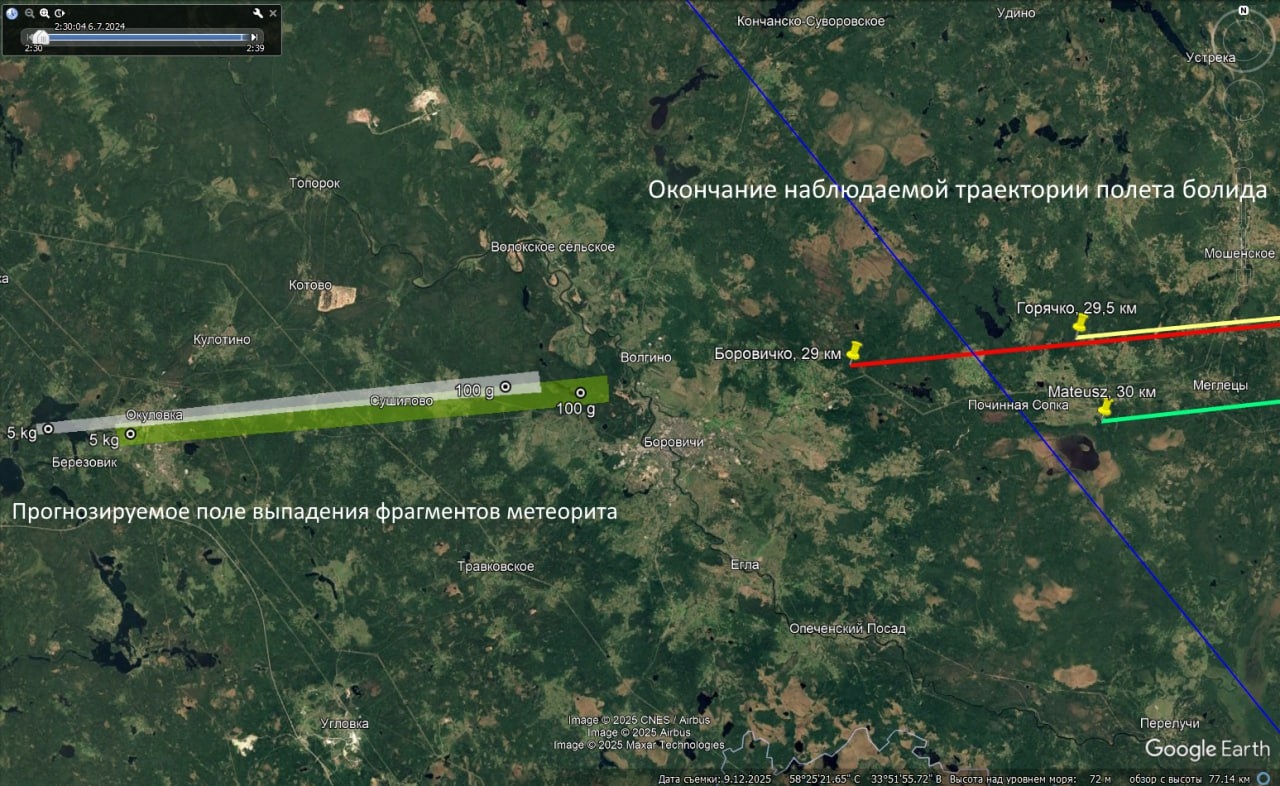
Mateusz Żmija’s calculated fall area and three calculated bolide trajectories (end of luminous trail): Goryachko (yellow line), Borovička (red line) and Żmija (green line).
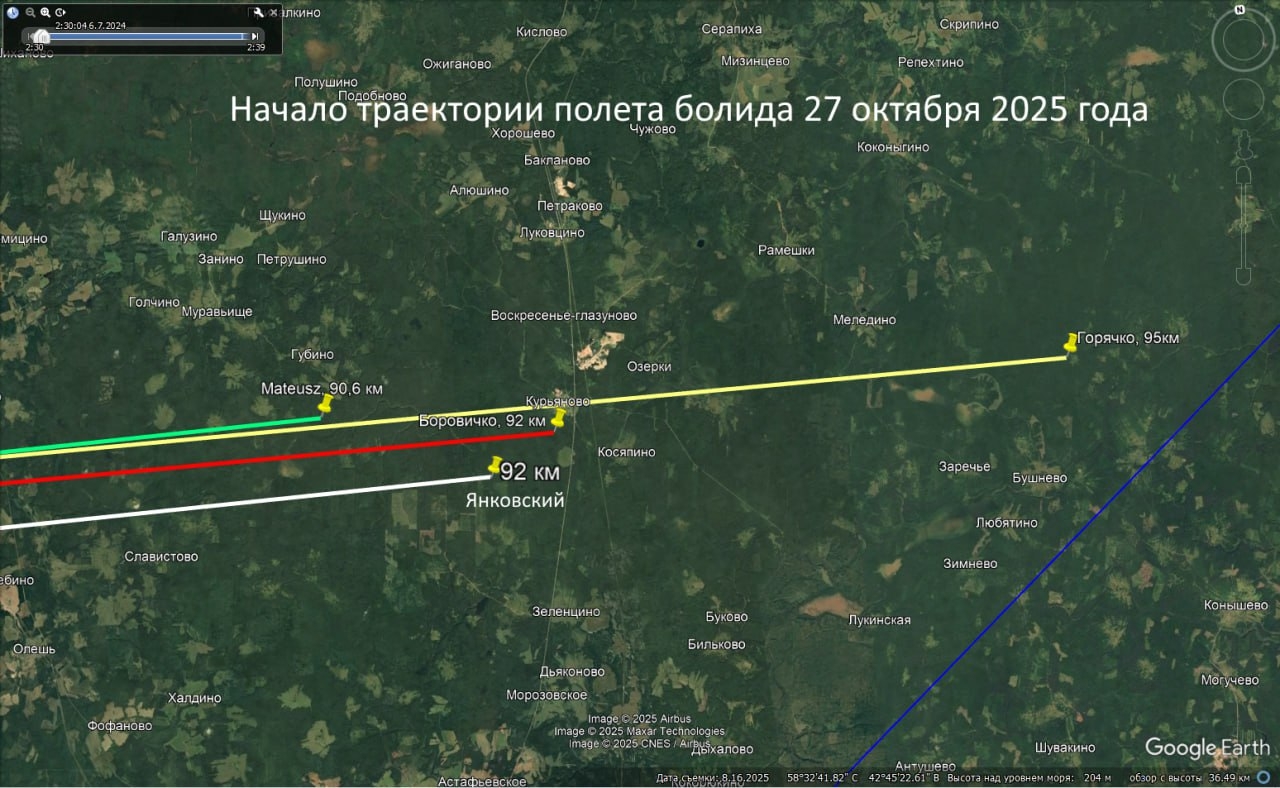
Three calculated bolide trajectories (start of luminous trail): Goryachko (yellow line), Borovička (red line) and Żmija (green line).
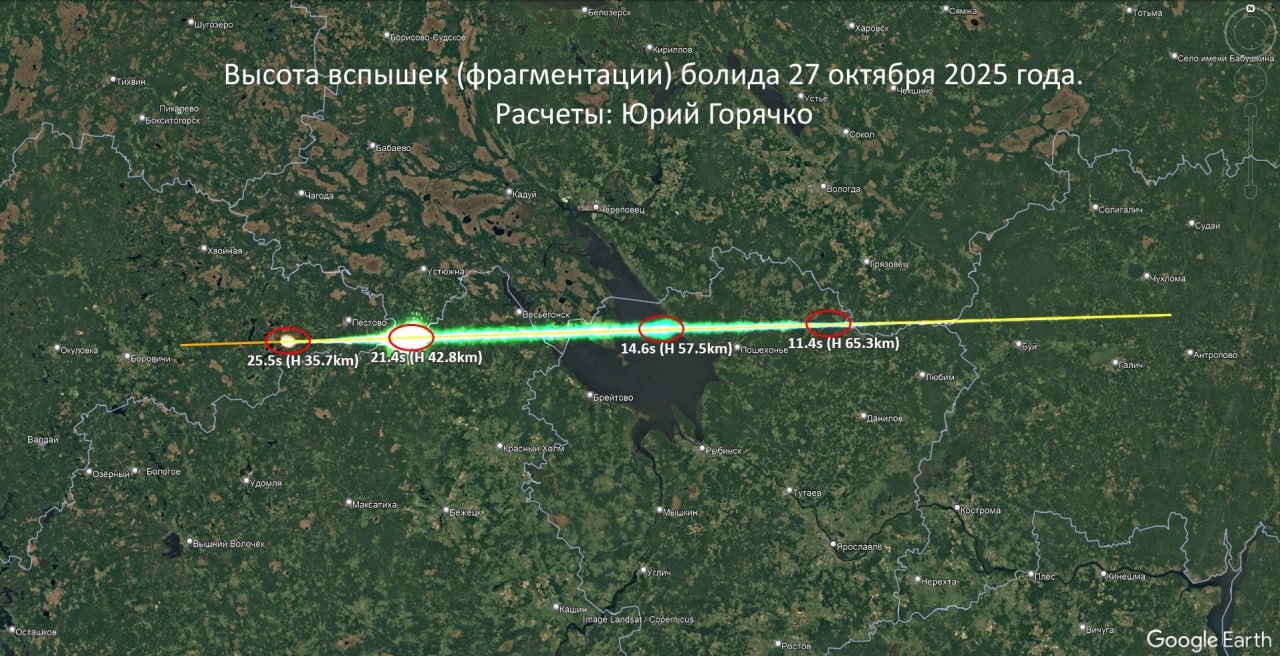
Main fragmentation events as calculated by Yuri Goryachko
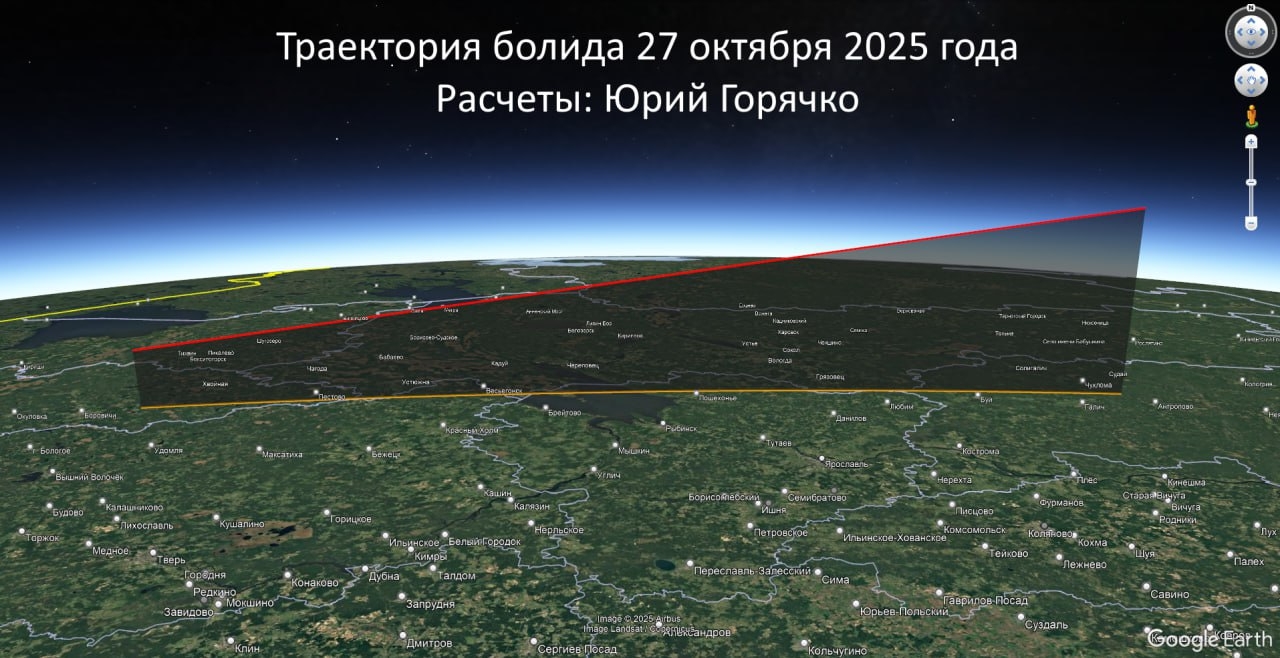
3D trajectory as calculated by Yuri Goryachko
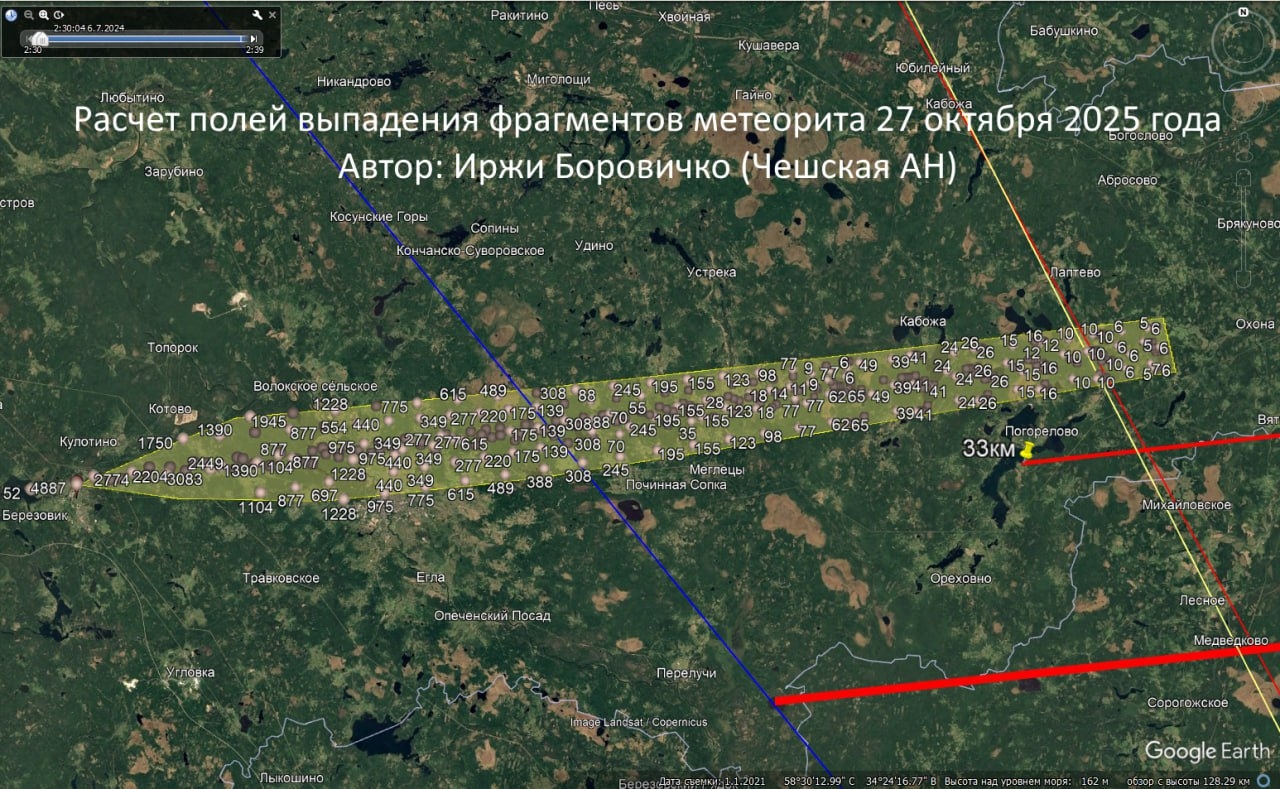
Calculated meteorite fall area. Calculation by Jiří Borovička.
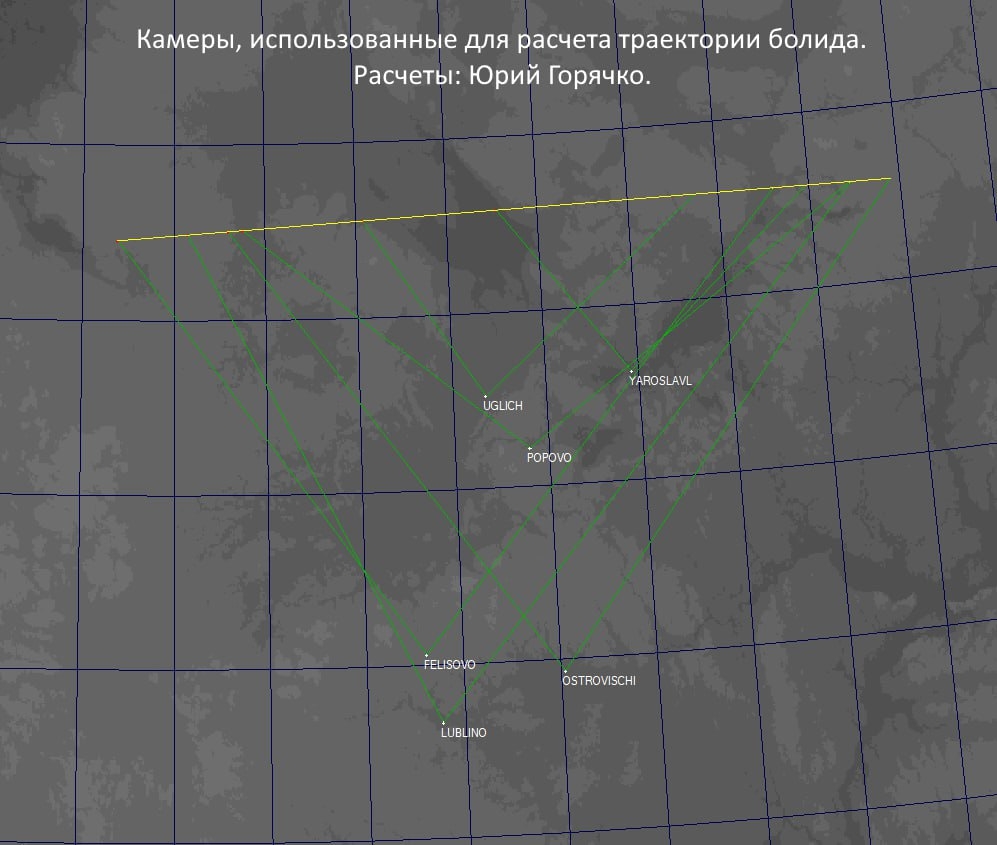
Cameras used by Yuri Goryachko for his calculations.
“Ilya Yankovsky (Starvisor) was the first to present the trajectory calculations. Mateusz Żmija, head of the Polish bolide network “Skytinel,” and Oleg Ugolnikov (IKI RAS), who based his calculations solely on photographs, were subsequently able to produce significantly lower accuracy. Then came calculations from Yuri Goryachko (coordinator of the Belarusian Meteor Network, Minsk), Professor Jiří Borovička (meteorite specialist, Czech Academy of Sciences), and Olga Popova (leading researcher at the Institute of Mining of the Russian Academy of Sciences. […]
Based on these calculations, three different forecasts of meteorite fragment fallout fields were generated by early November (by Mateusz Żmija, Olga Popova, and Jiří Borovička), and these forecasts were transmitted to the search teams at the Vernadsky Institute of Geochemistry and Analytical Chemistry of the Russian Academy of Sciences and Ural Federal University.
The most accurate match between the bolide’s flight paths was achieved by Yuri Goryachko and Jiří Borovička. Their trajectories also closely matched the predicted meteorite fragment fallout fields.
The latitude difference between the Goryachko trajectory (yellow line) and Jiří Borovička (red line) is only 400 meters! 6 km further south is the trajectory from Mateusz Żmija (green line). […]
As a result, three trajectories can be considered with a high degree of certainty: those of Yuri Goryachko, Jiří Borovička, and Mateusz Żmija. Both Yuri and Jiří are experienced bolide trajectory calculators. They calculated independently, and their trajectories were virtually identical! Moreover, they coincided with the predicted direction of the meteorite fragment fallout fields. Taken together, these trajectories carry the greatest weight. Finally, the final convincing proof of the correct calculations is the meteorite fragment eventually found in the town of Okulovka (Novgorod Oblast), where all three predicted fragment fallout fields converge. Wind is taken into account. […]
The entry velocity into the Earth’s atmosphere was 18 km/sec […]. At the end of the meteorite’s visible flight, its velocity slowed to 4 km/sec, and it hit the ground at a speed of approximately 100 m/sec. The meteorite entered the Earth’s atmosphere at a very shallow angle of 9°, greatly complicating the calculation of its trajectory and the fallout field of its fragments, which fell in an ellipse measuring 75 x 3 km.
The meteorite’s expected density is approximately 3 g/cm³, its mass before entering the Earth’s atmosphere was approximately 2,000 kg, and its diameter was approximately 1 meter. The altitude at which stationary video cameras began recording the meteorite’s flight was approximately 95 km, and the altitude at which they ended was approximately 29 km. The meteorite flew almost exactly east to west.
The minimum distance from the center of Moscow to the meteorite’s flight path was 300 km, and to the fragment fallout site, 400 km. All fragments fell in the eastern Novgorod region in an ellipse measuring 75 x 3 km.
The meteoroid’s orbit in the Solar System before impact with Earth was a = 1.41 AU, e = 0.46, i = 5.00°, indicating that it belonged to the Apollo group: it entered Earth’s orbit, reached the orbit of Venus, and then departed beyond the orbit of Mars. This orbit is similar to the near-Earth asteroids (35396) 1997XF11 and (1862) Apollo.” Text by Stanislav Aleksandrovich Korotki (AstroAlert)

Comparison of the calculated data by (top to bottom) Oleg Ugolnikov, Ilya Yankovsky, Mateusz Żmija, Yuri Goryachko, Jiří Borovička. Entry velocity – end velocity – entry angle – trajectory start and end altitudes (km) – orbital data – geocentric radiant – fragmentation altitudes
Skytinel trajectory calculations: To calculate the meteoroid’s trajectory, orbit, and search area the Polish Skytinel team used visual recordings sent in by Stanislav Korotkiy (Станислав Короткий) and Yevgeny Trofimov (Евгений Трофимов). Recordings from Moscow [Lyublino-Maryino] provided by Stanislav Korotkiy, Barybino [Domodedovo district], provided by Alexander Gusev, Felisovo, Ostrovishchi, Popovo and Uglich were used. Calculations revealed that the 31-second westward-moving bolide started at an altitude of 90.6 km over the Kostroma Oblast with an initial velocity of 18 km/s. The entry angle of the bolide was only 9° relative to Earth’s surface and it passed Yaroslavl, Tver, and Novgorod Oblasts while traveling about 500 kilometres. The bolide’s maximum dynamic pressure was calculated to be 1.14 MPa and the main fragmentation events occurred at altitudes of 43, 41 and 36 km (here with an estimated remaining mass of 30-90 kg). The meteoroid’s orbital period was calculated to be about 1 year and 9 months and its orbital inclination was 5.5° relative to the ecliptic plane, and at perihelion it approached the Sun to a distance of 0.7459 AU. More information provided by Mateusz Żmija can be found on this Skytinel page, published on 10 November 2025. More videos of the bolide can be seen at Evgeniy Trofimov’s page Метеорит основная масса. Gábor Kővágó has posted his dark flight calculations here on 29 November 2025.
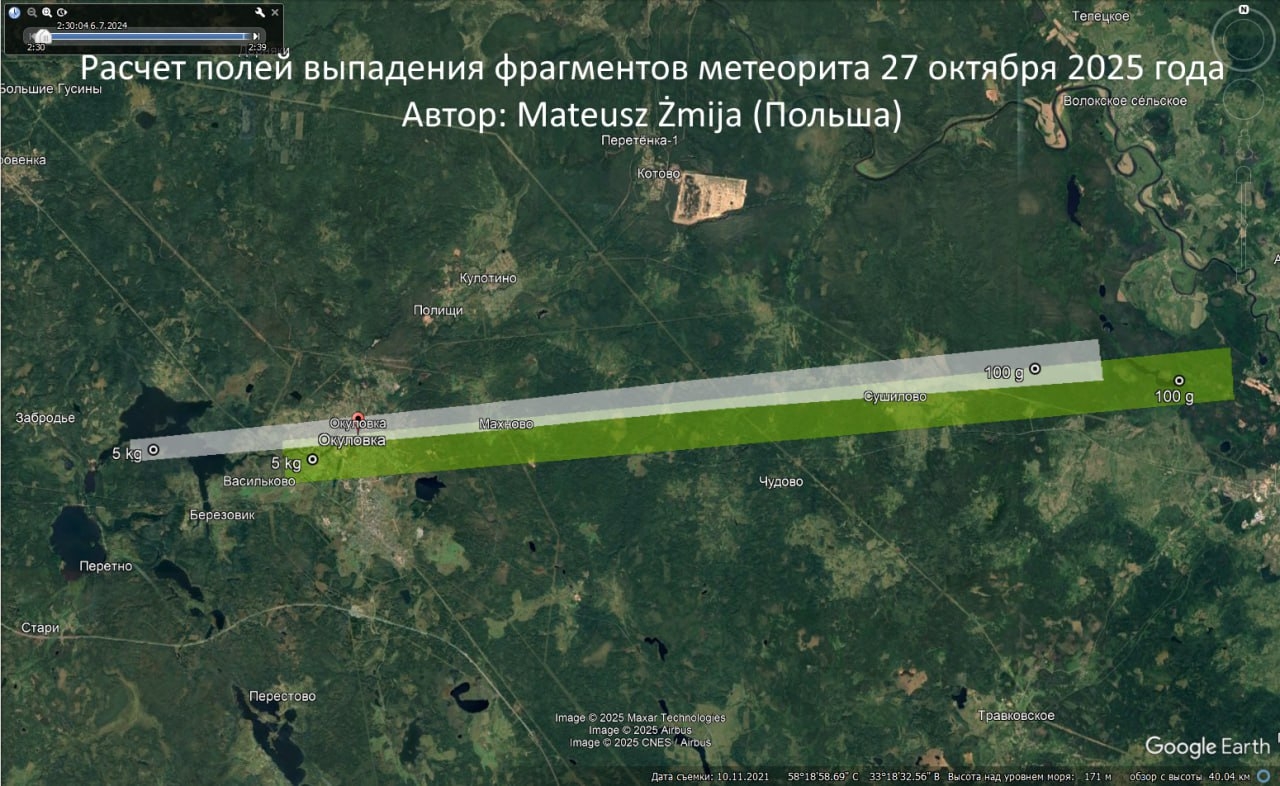
Adapted calculated meteorite fall zone, mapped by Gábor Kővágó and Mateusz Żmija
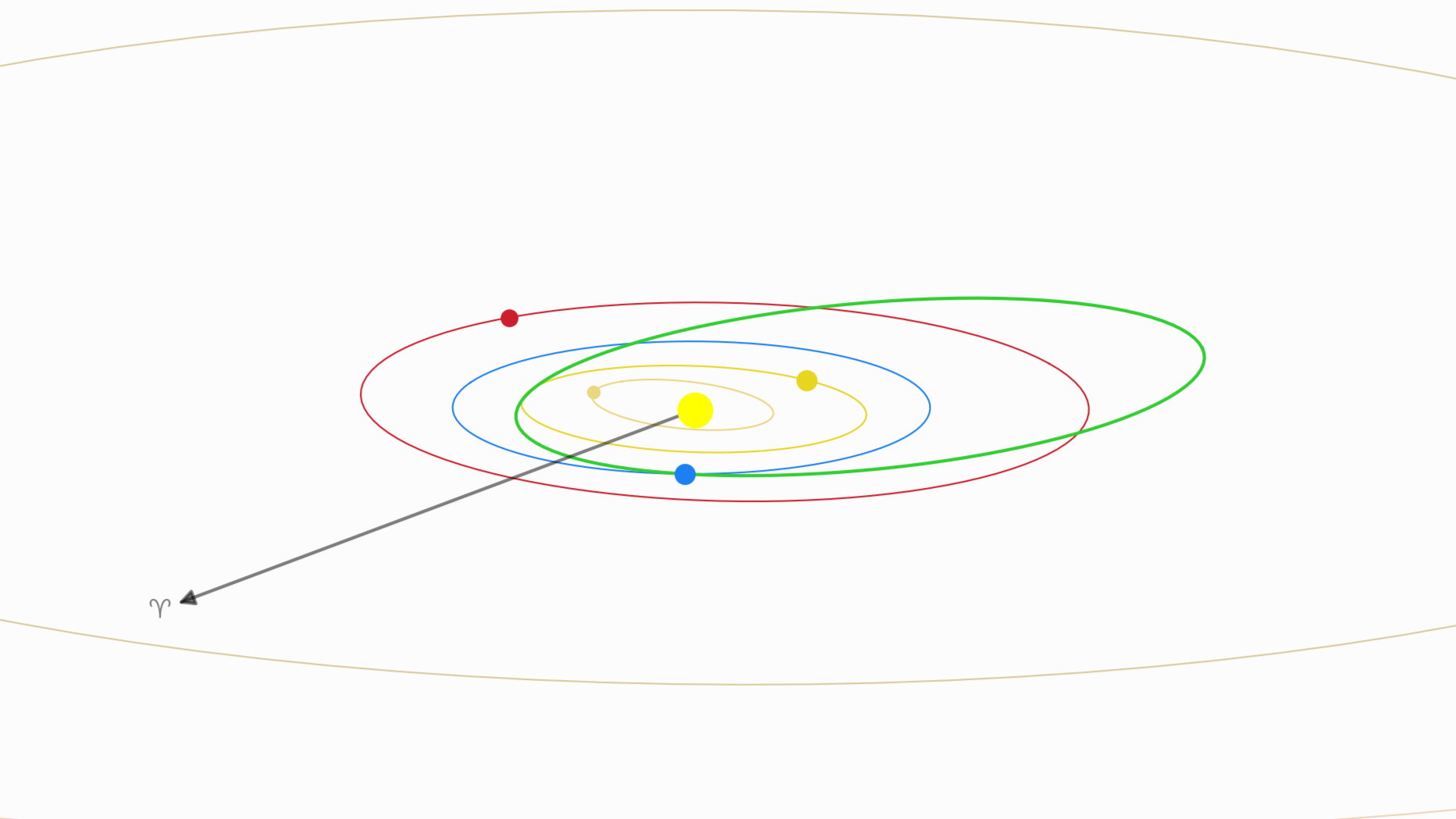
The meteoroid’s calculated preatmospheric orbit provided by Mateusz Żmija
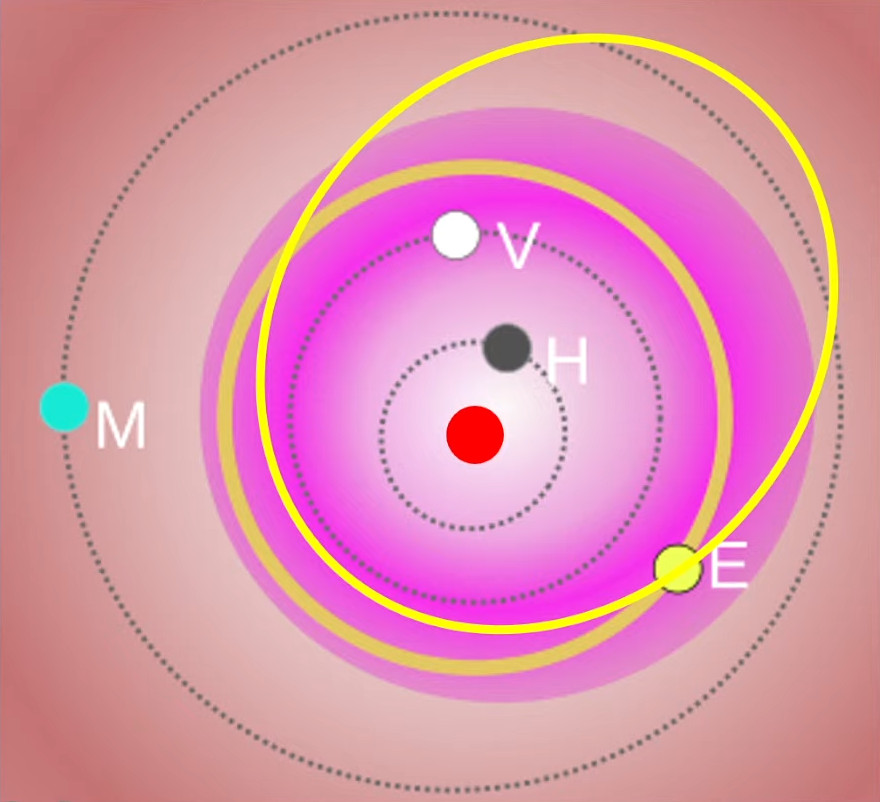
The meteoroid’s calculated preatmospheric orbit. Photo: ГЕОХИ РАН (20 November 2025)
More information will be added here soon.
Meteorite fragments from rooftop
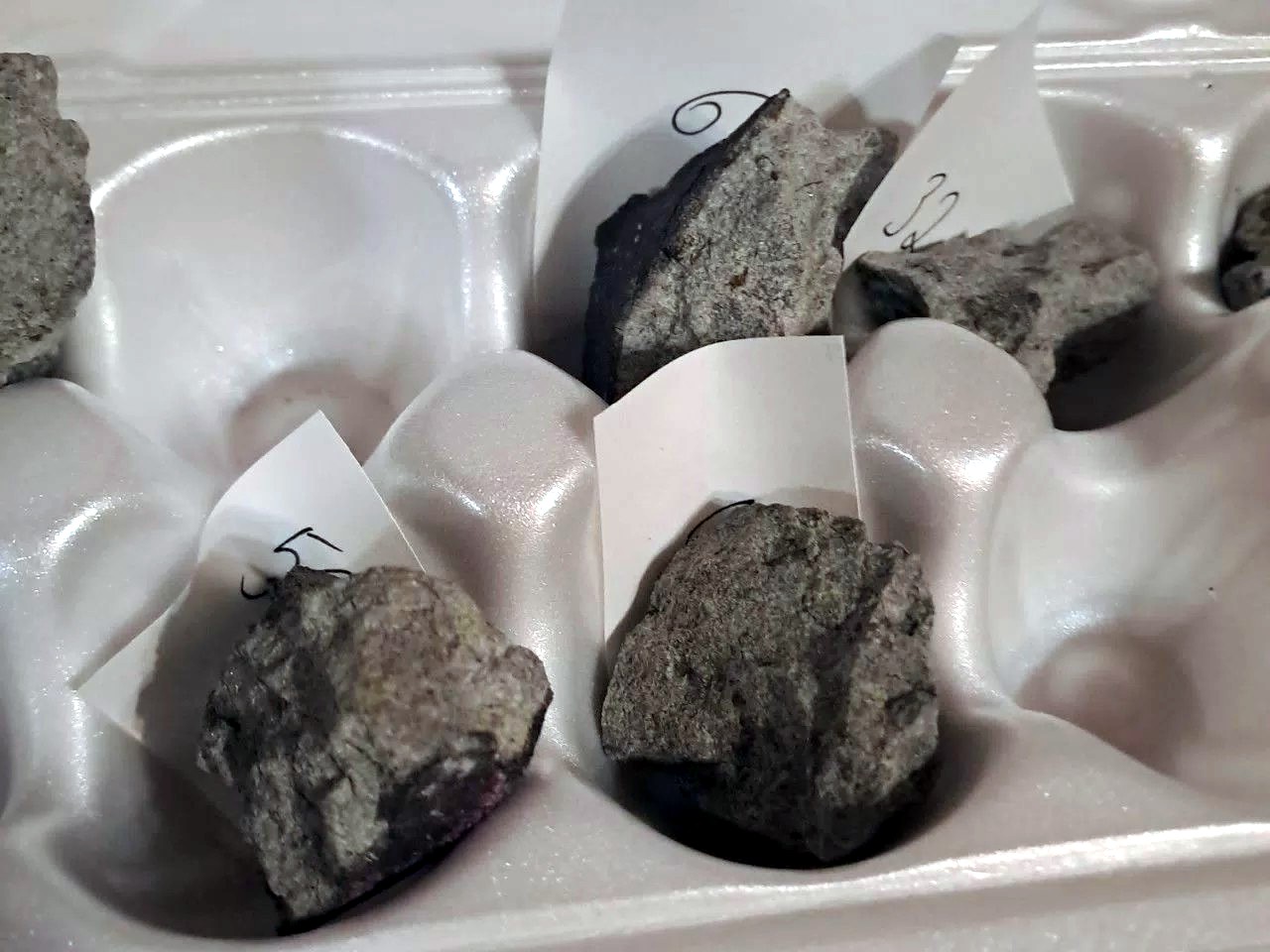
Photo: Tatyana
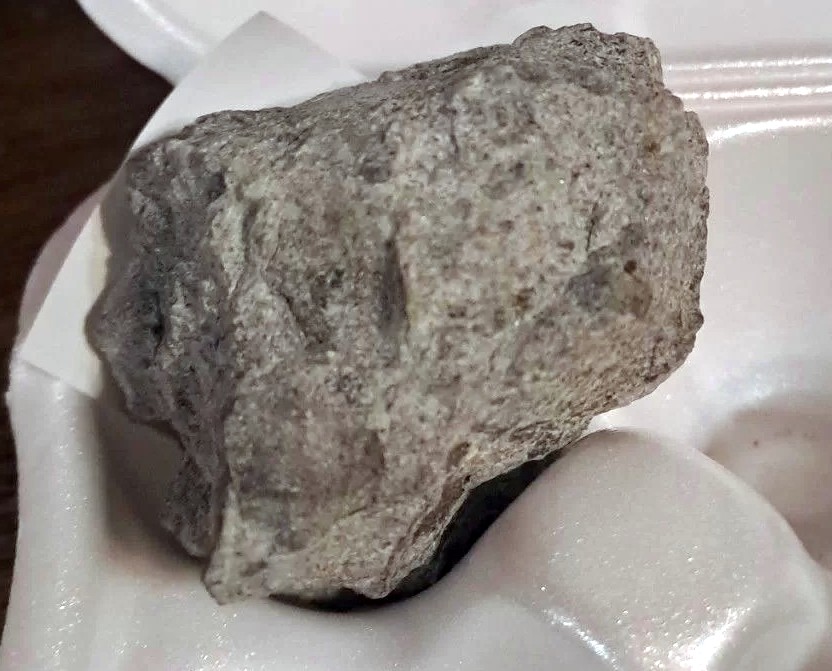
Photo: Tatyana
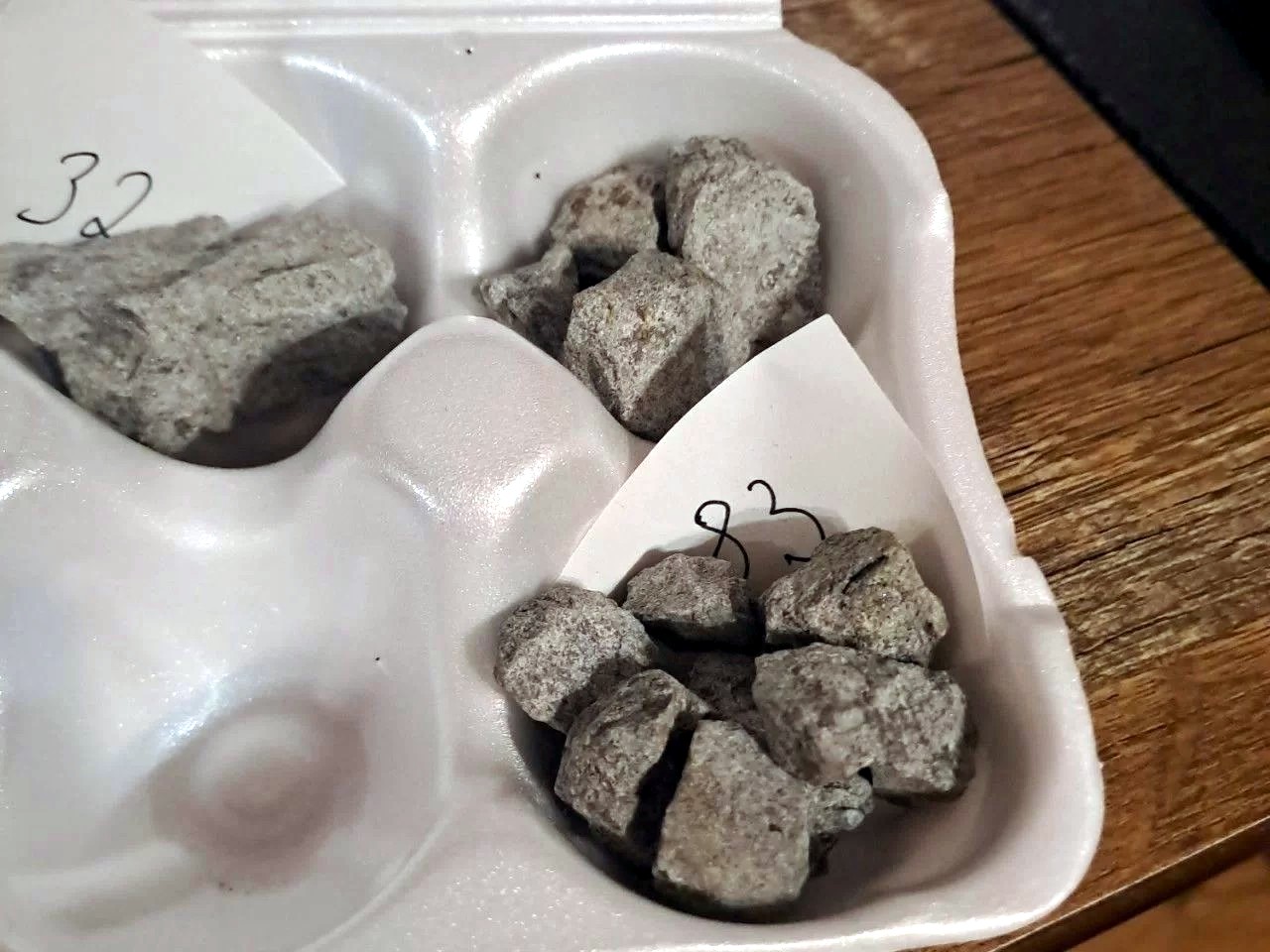
Photo: Tatyana

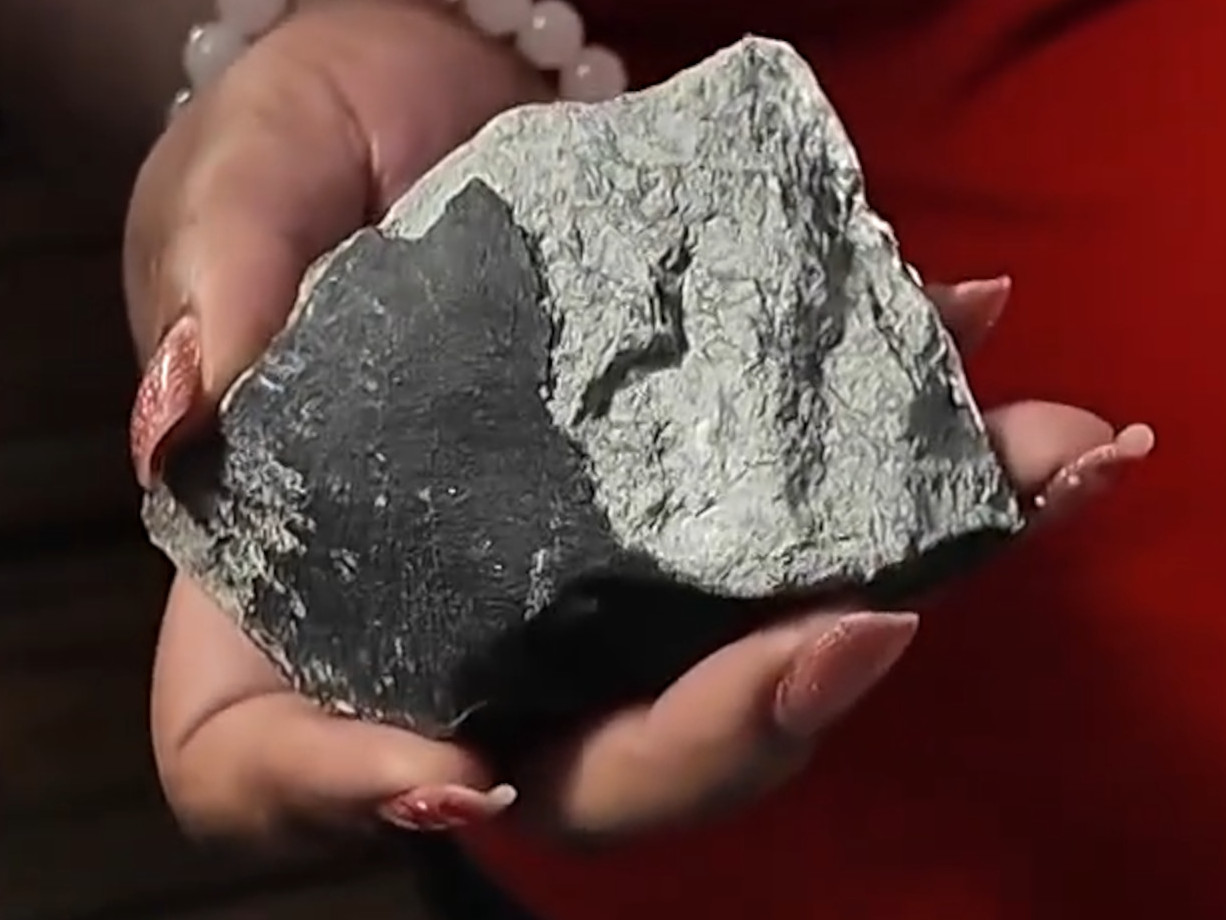
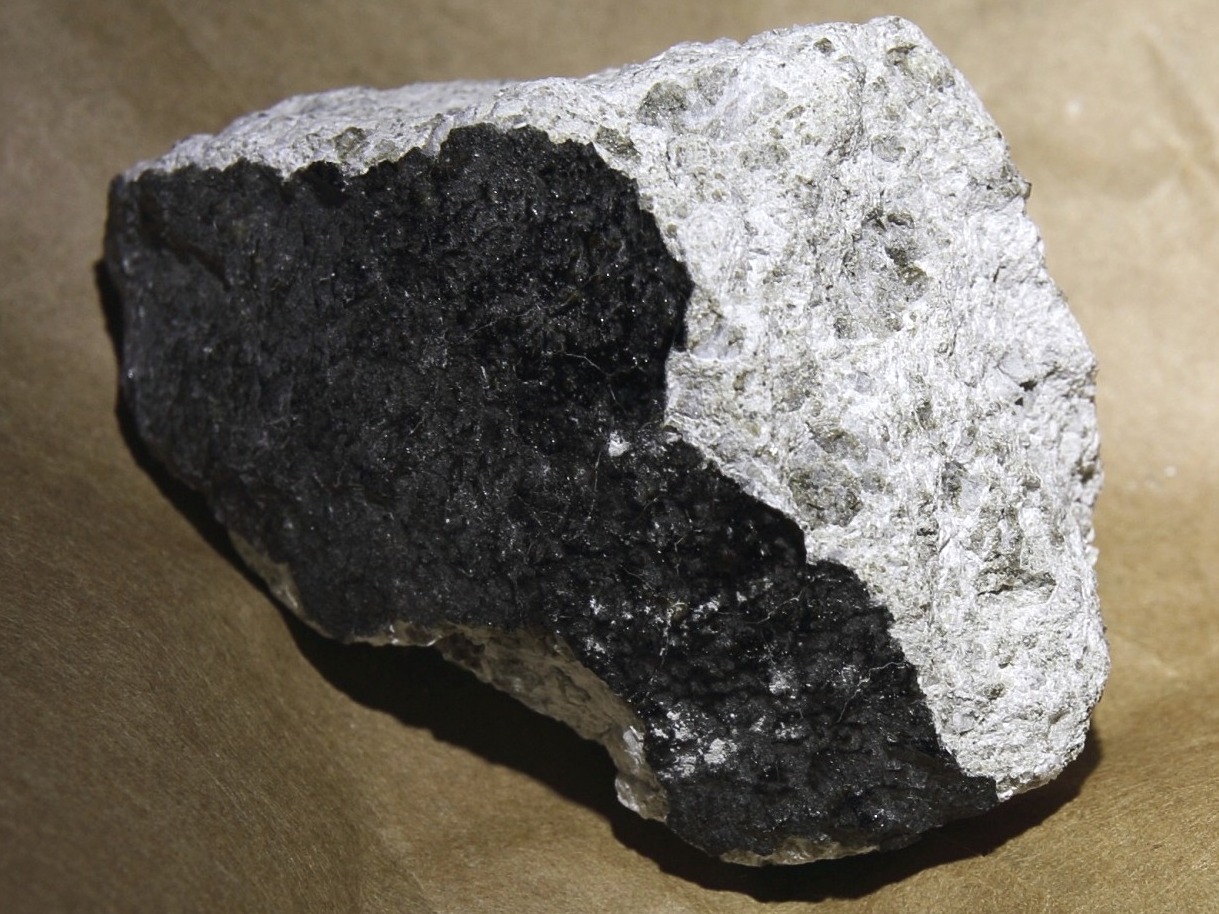
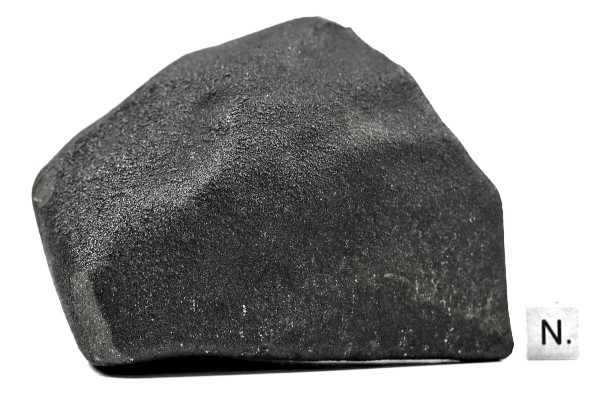
A 62.325-gram fragment (~4×3 cm) of the meteorite which will be added to the collection of the Russian Academy of Sciences. It is the fragment with the largest fusion-crusted surface. Photo: Konstantin Ryazantsev
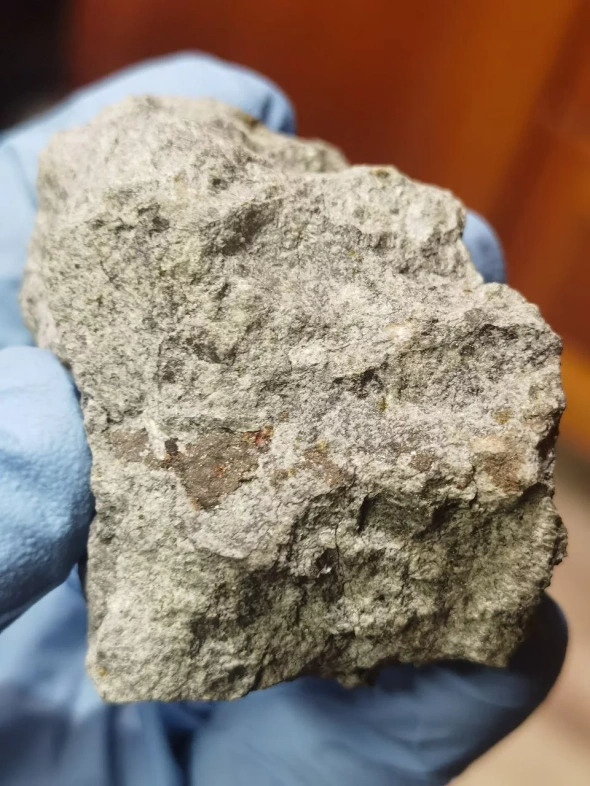
A 62.325-gram fragment (~4×3 cm) of the meteorite. Photo: Konstantin Ryazantsev
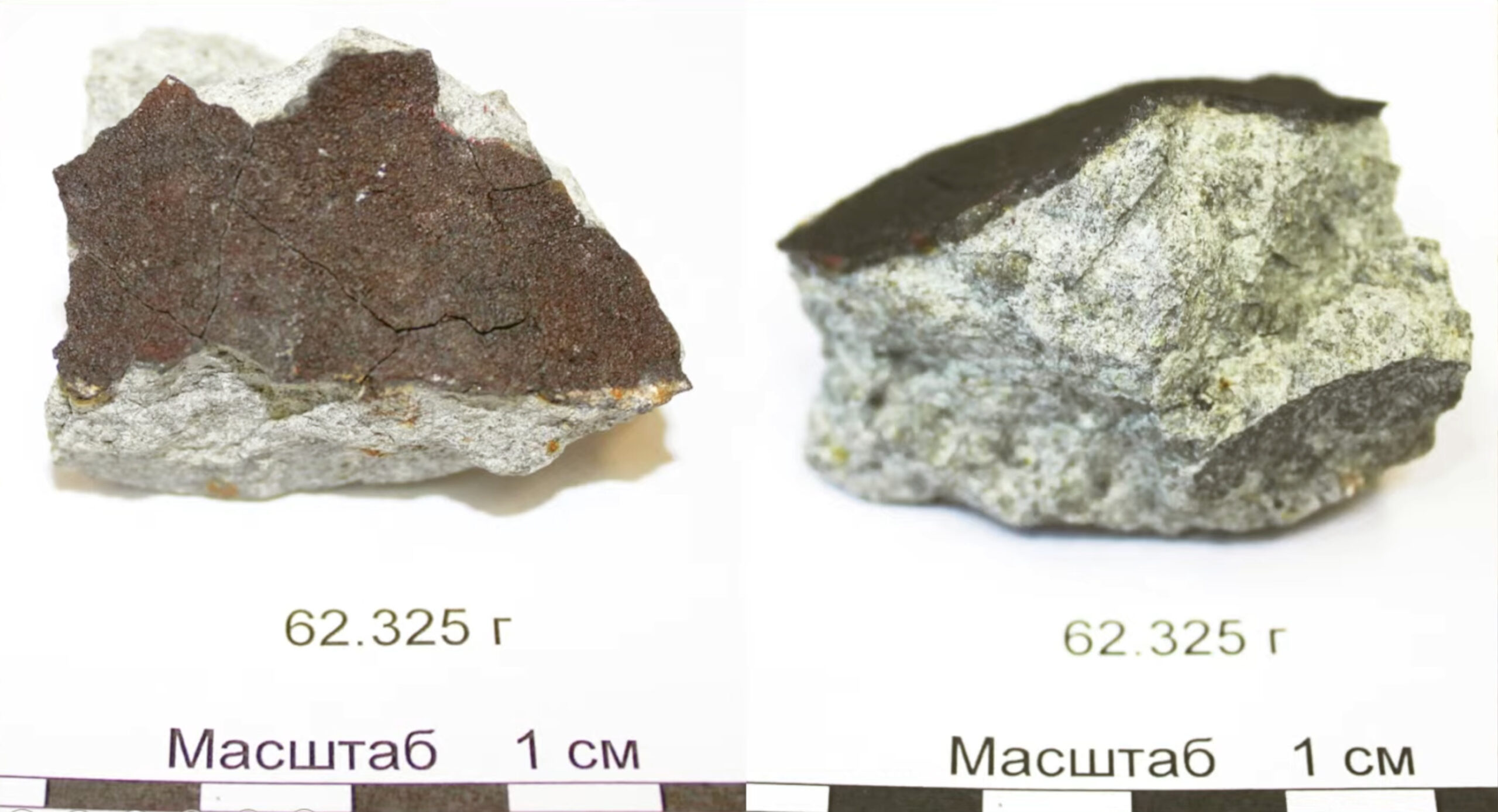
A 62.325-gram fragment (~4×3 cm) of the meteorite. Photo: ГЕОХИ РАН (20 November 2025)
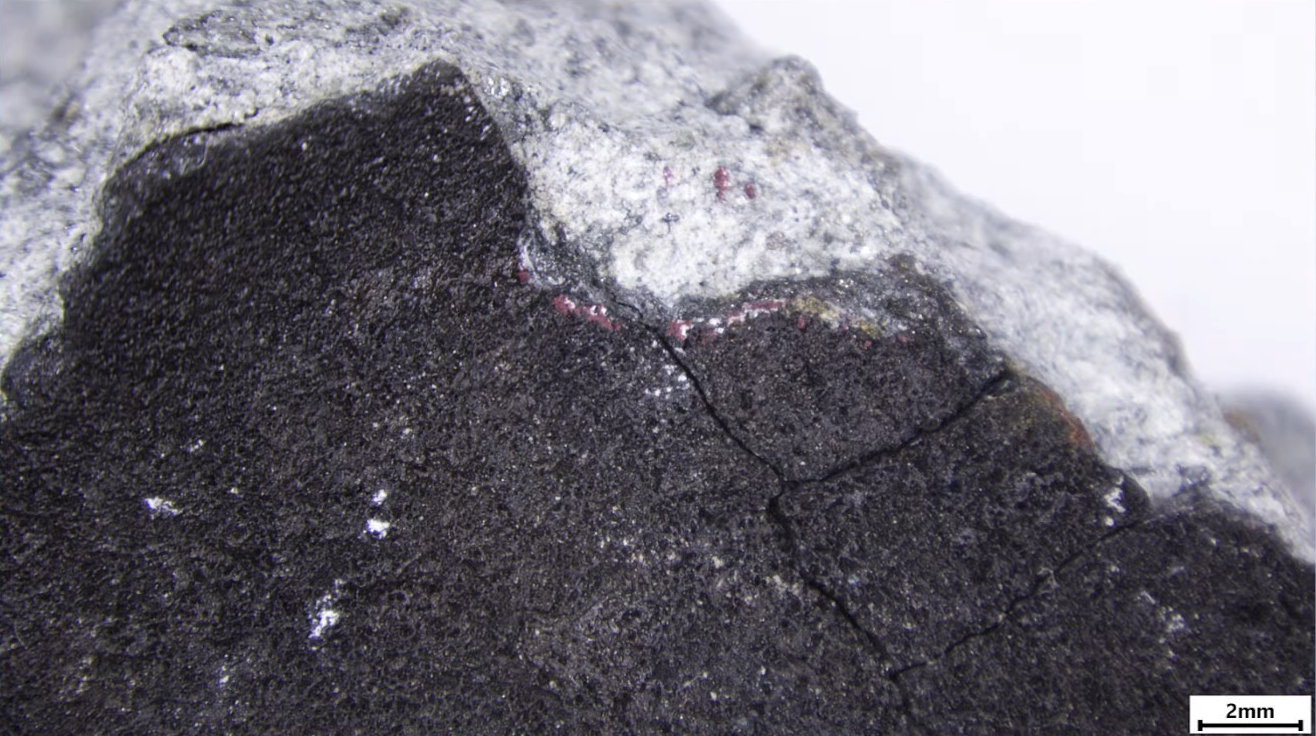
The 62.325-gram fragment (~4×3 cm) showing traces of its impact on the red rooftop. Photo: ГЕОХИ РАН (20 November 2025)
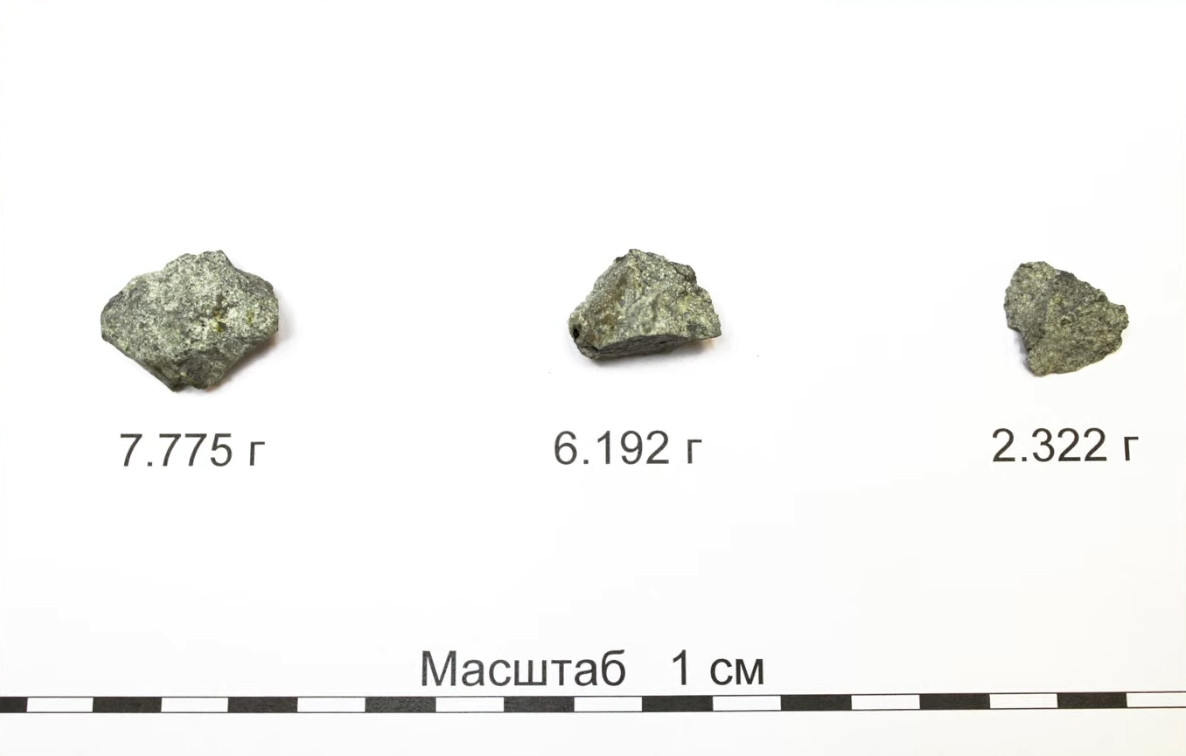
First three fragments (7.775 g, 6.192 g and 2.322 g (used for thin section)) sent to the laboratory for analysis. Photo: ГЕОХИ РАН (20 November 2025)
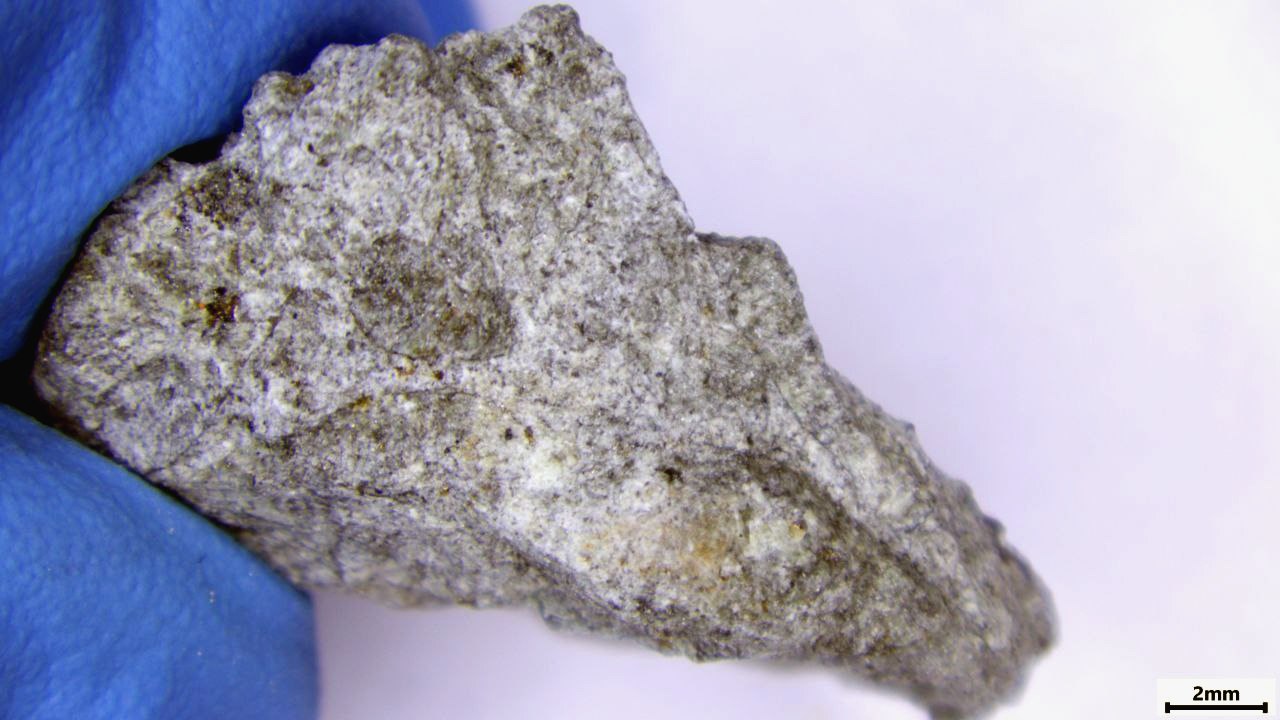
Photo: Konstantin Ryazantsev
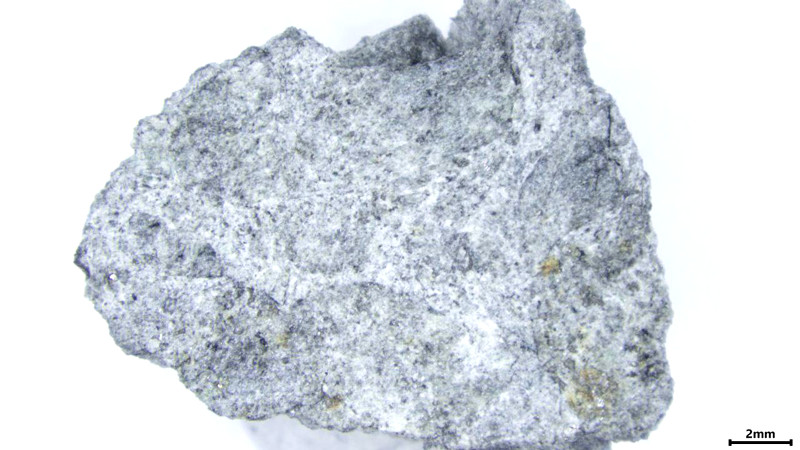
Photo: Konstantin Ryazantsev
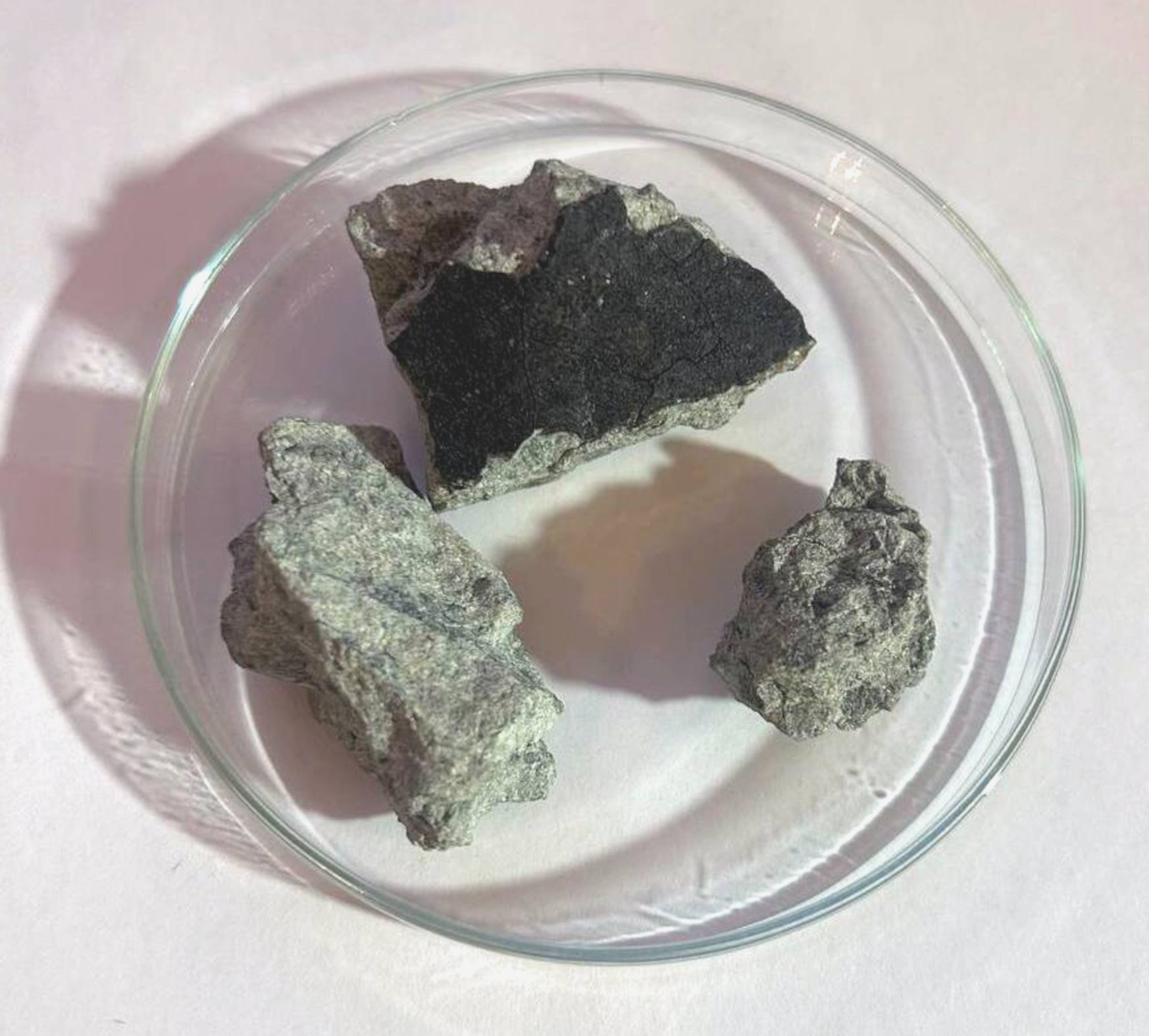
Three meteorite fragments presented at the press conference on 20 November 2025. Photo: Novgorod News
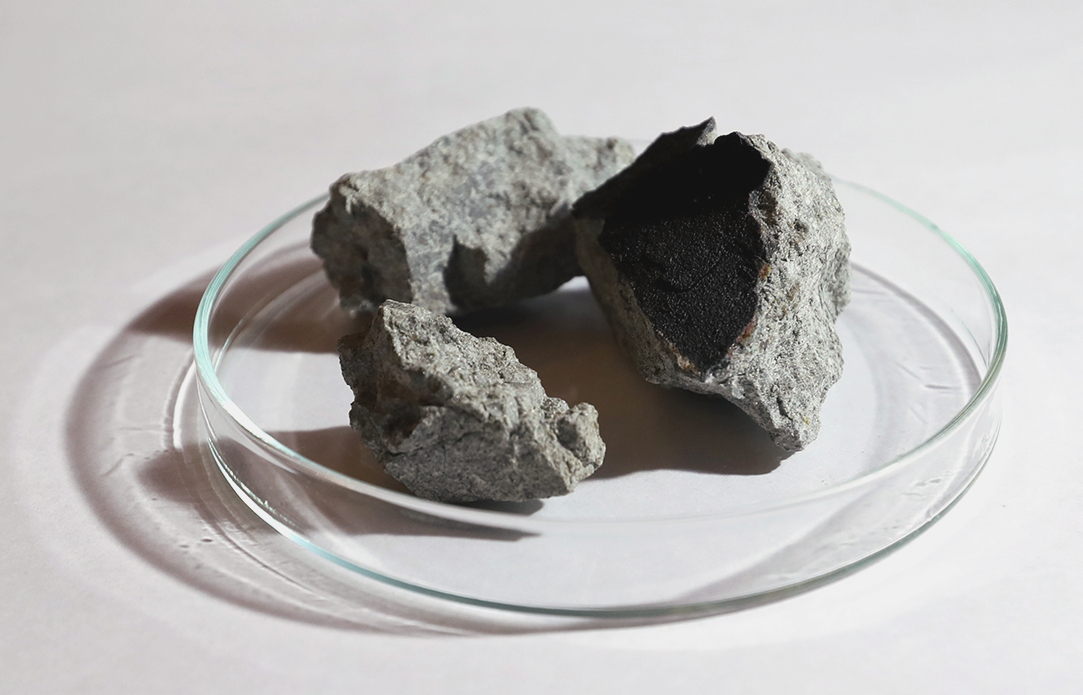
Three meteorite fragments presented at the press conference on 20 November 2025. Photo: MKRU
Konstantin Ryazantsev (Константин Рязанцев) presenting the 62.325-gram fragment at the press conference. Video: MKRU
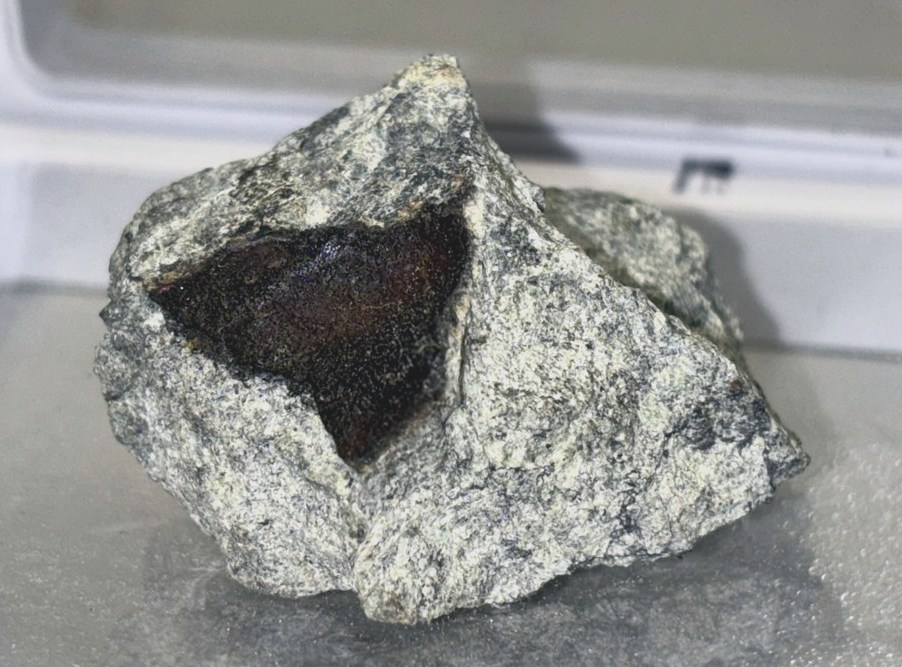
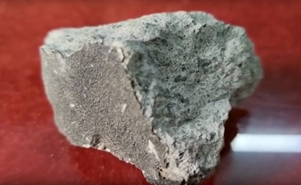
The 33.2-gram fragment which was sent to Ural Federal University (UrFU/УрФУ) for analysis. Photo: УрФУ
Impact location on rooftop
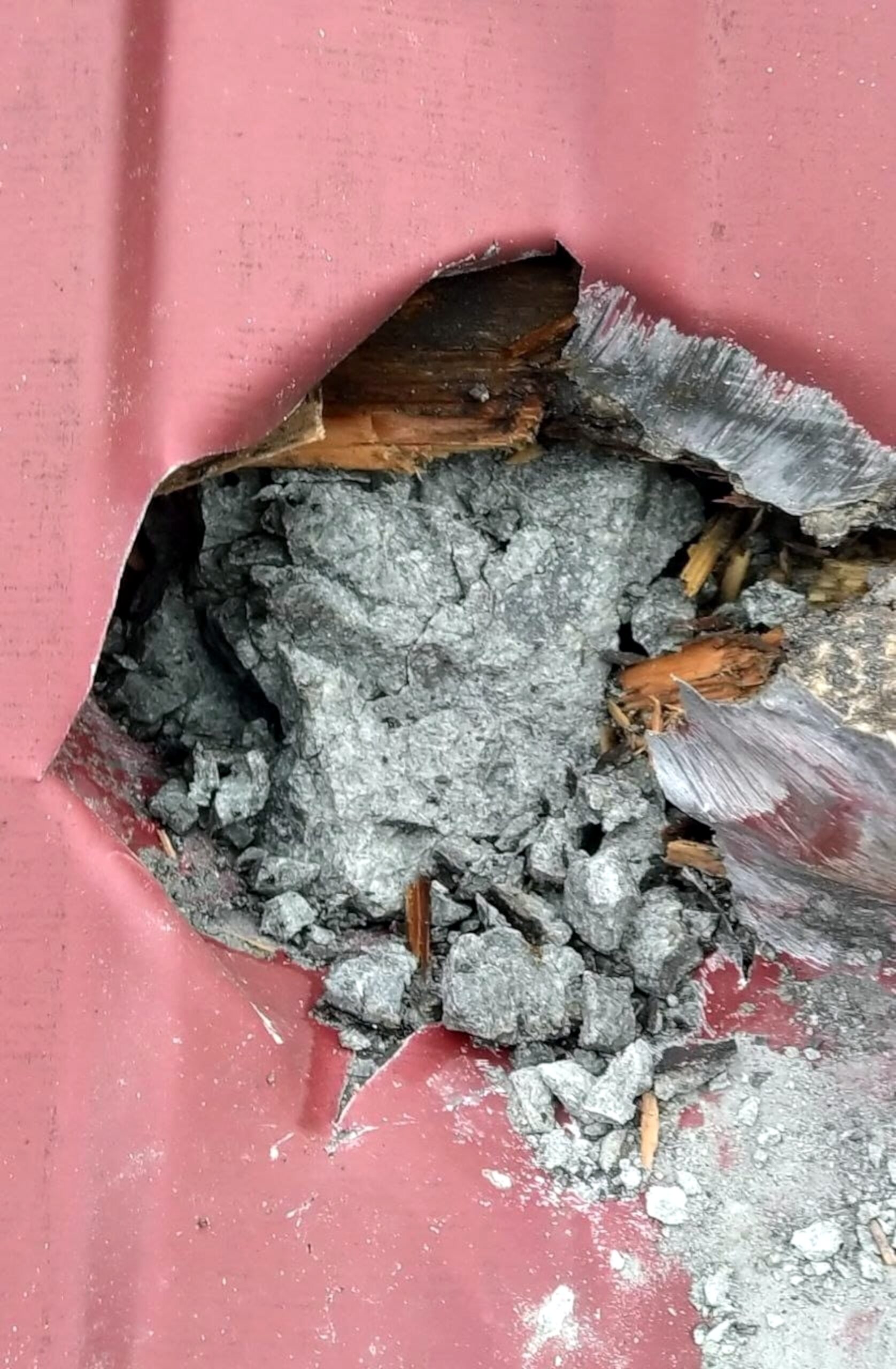
Photo: Tatyana
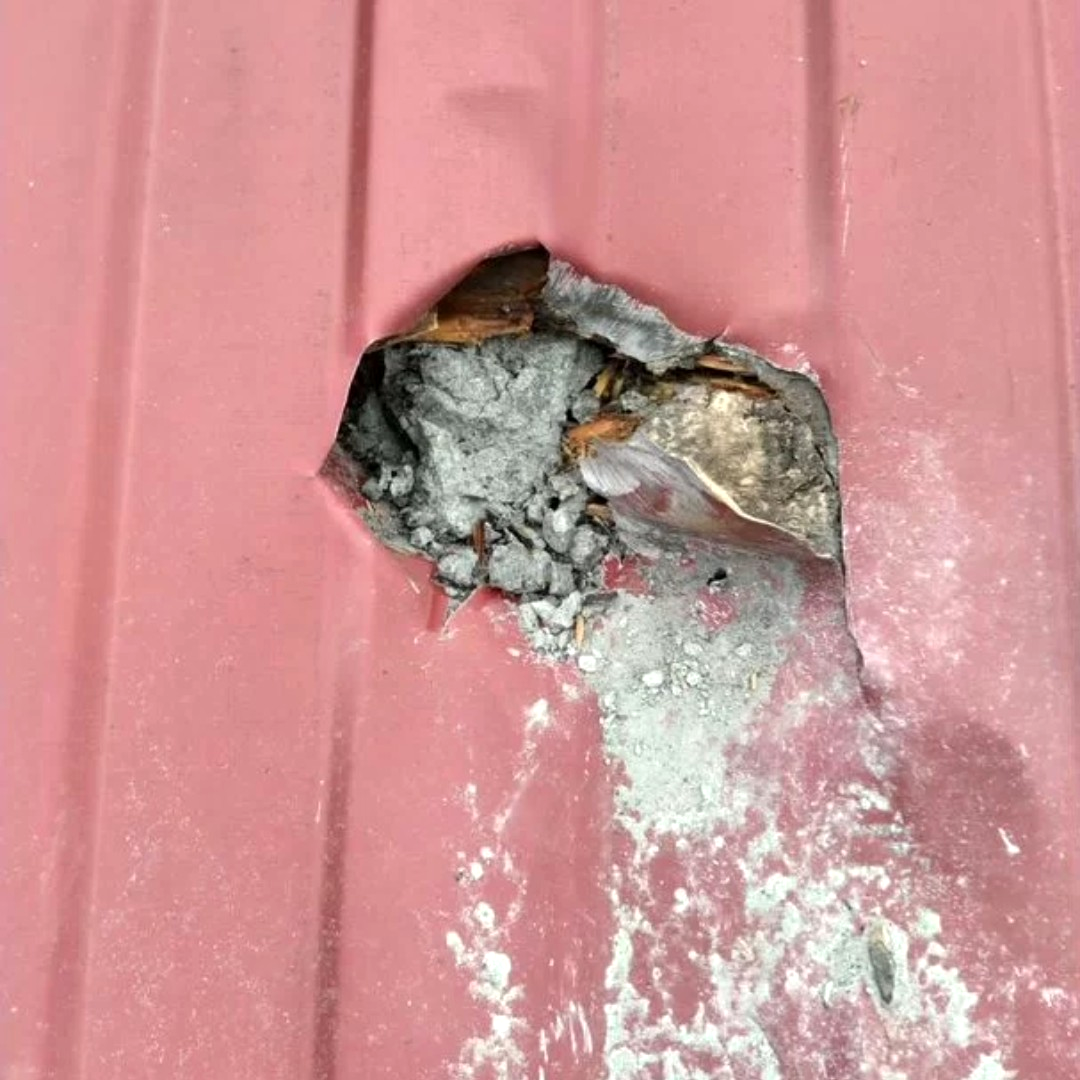
Photo: Tatyana
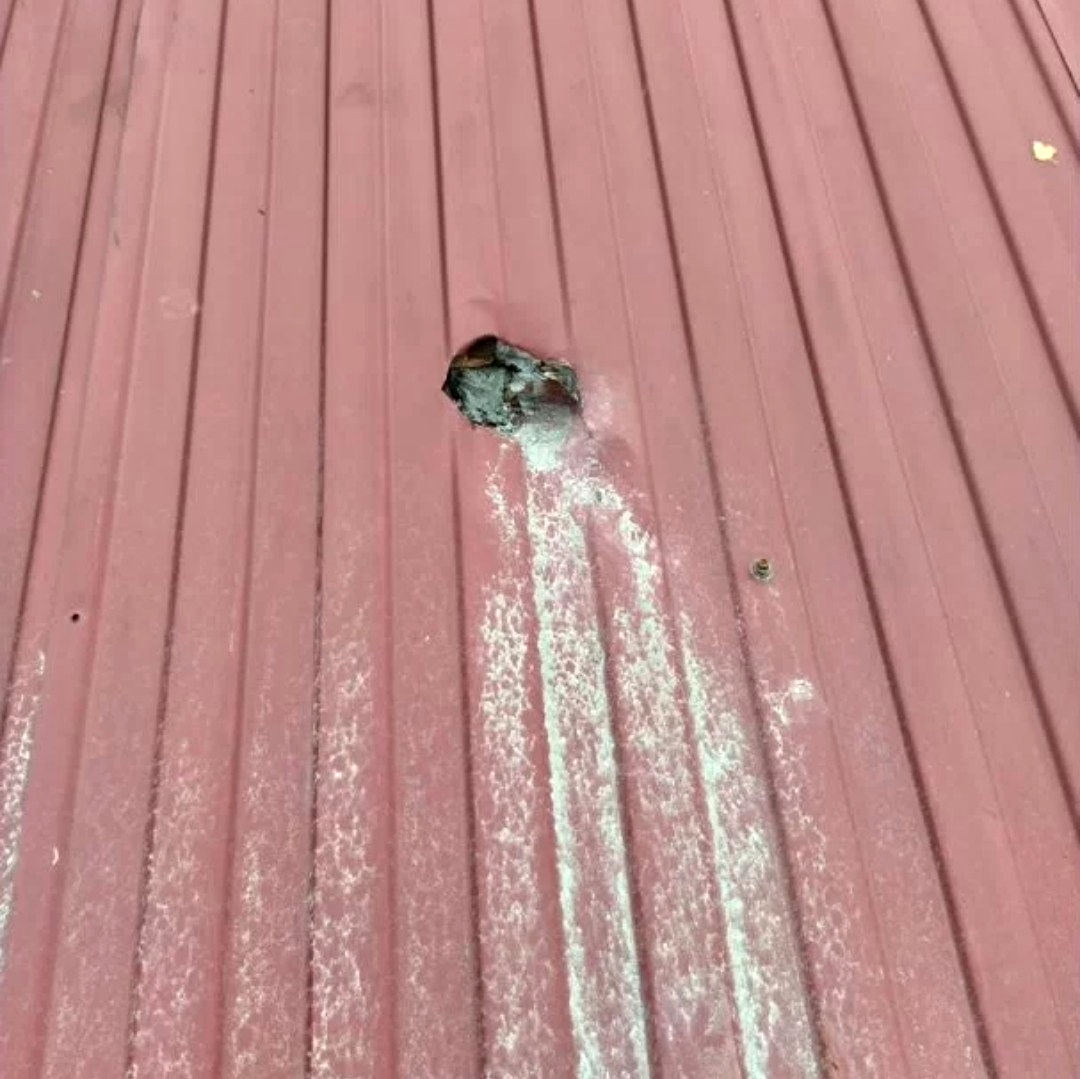
Photo: Tatyana
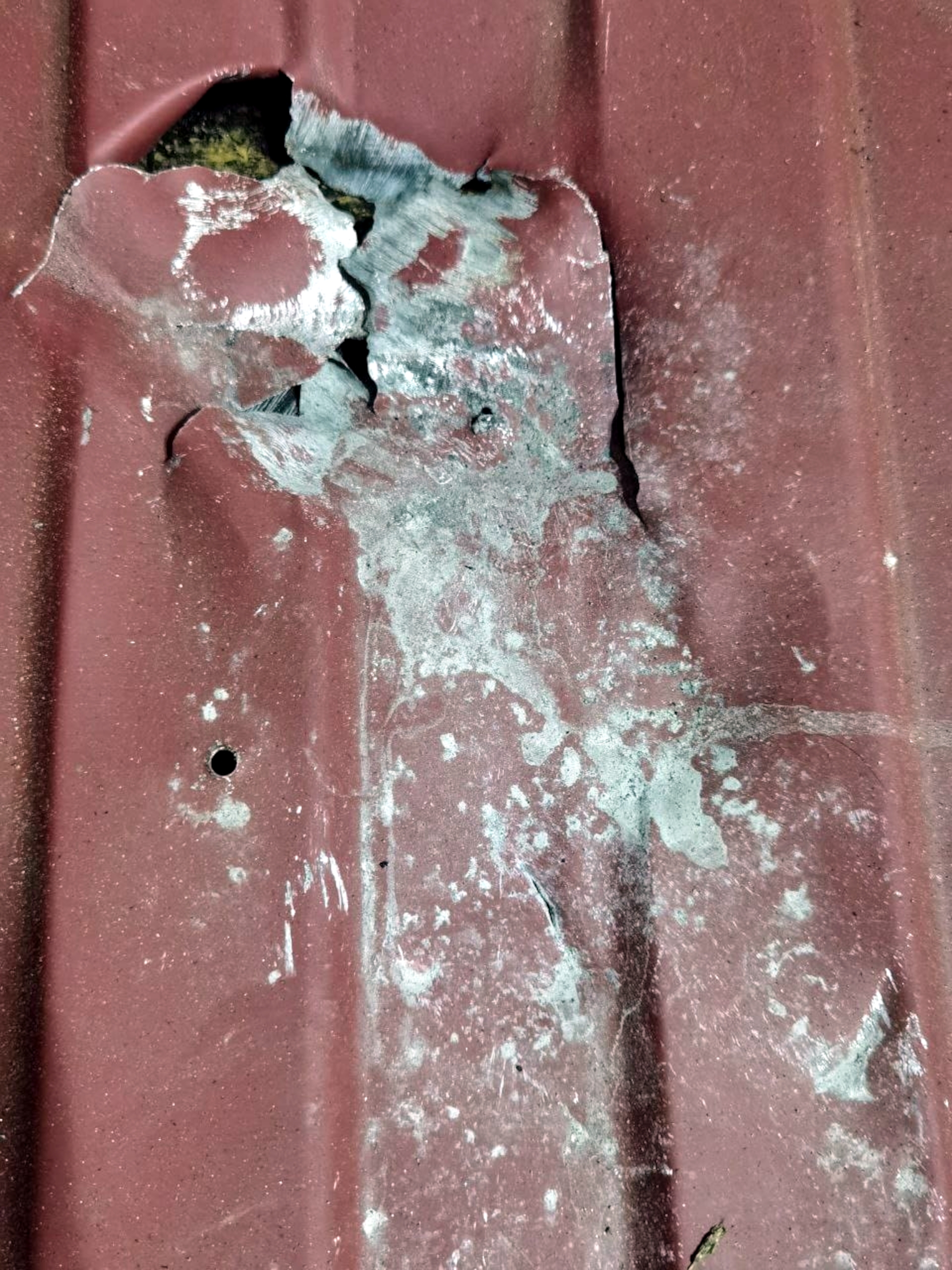
Photo: Konstantin Ryazantsev
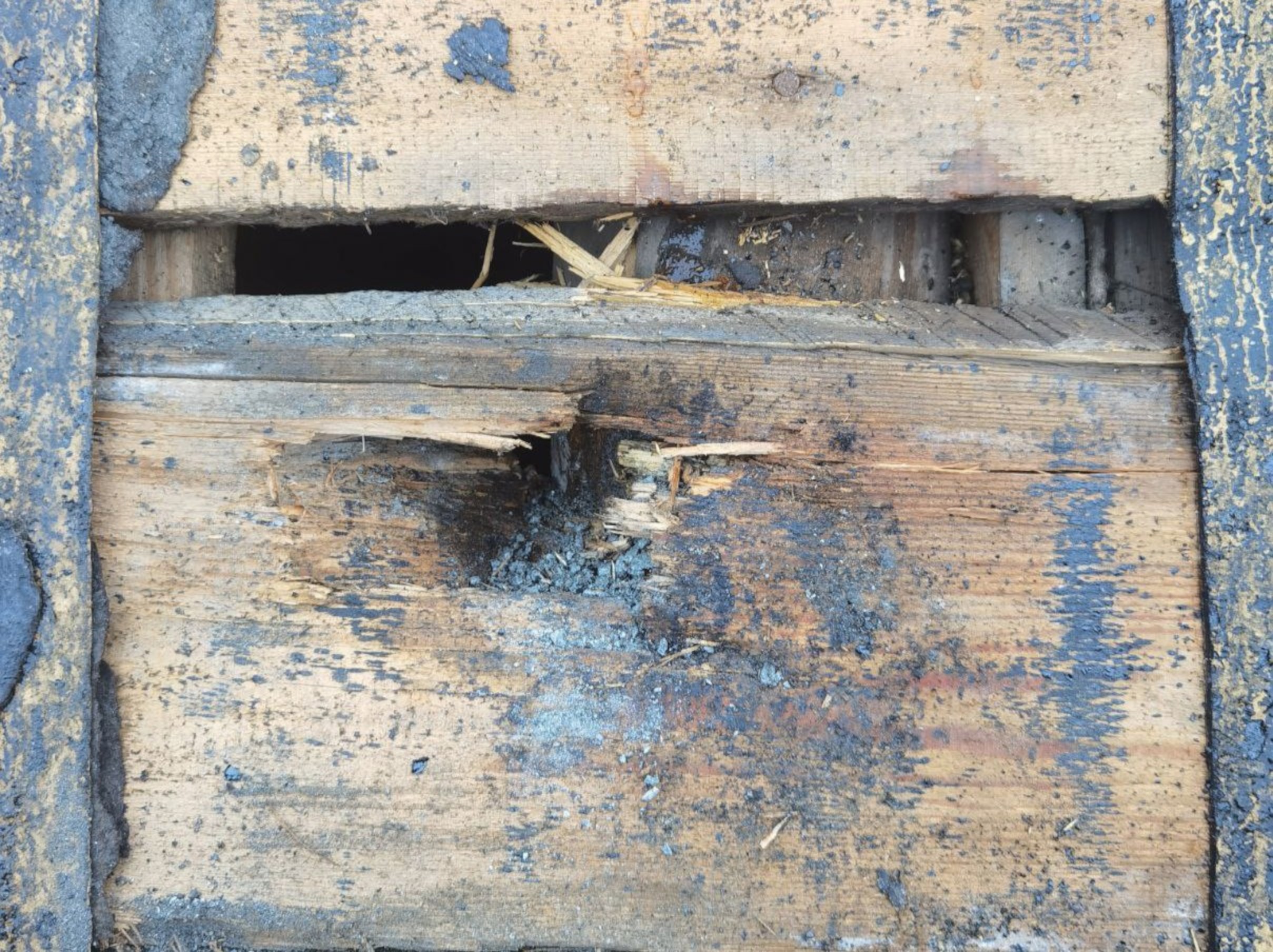
The pierced wooden roof beam with remaining smaller meteorite fragments. Photo: Konstantin Ryazantsev
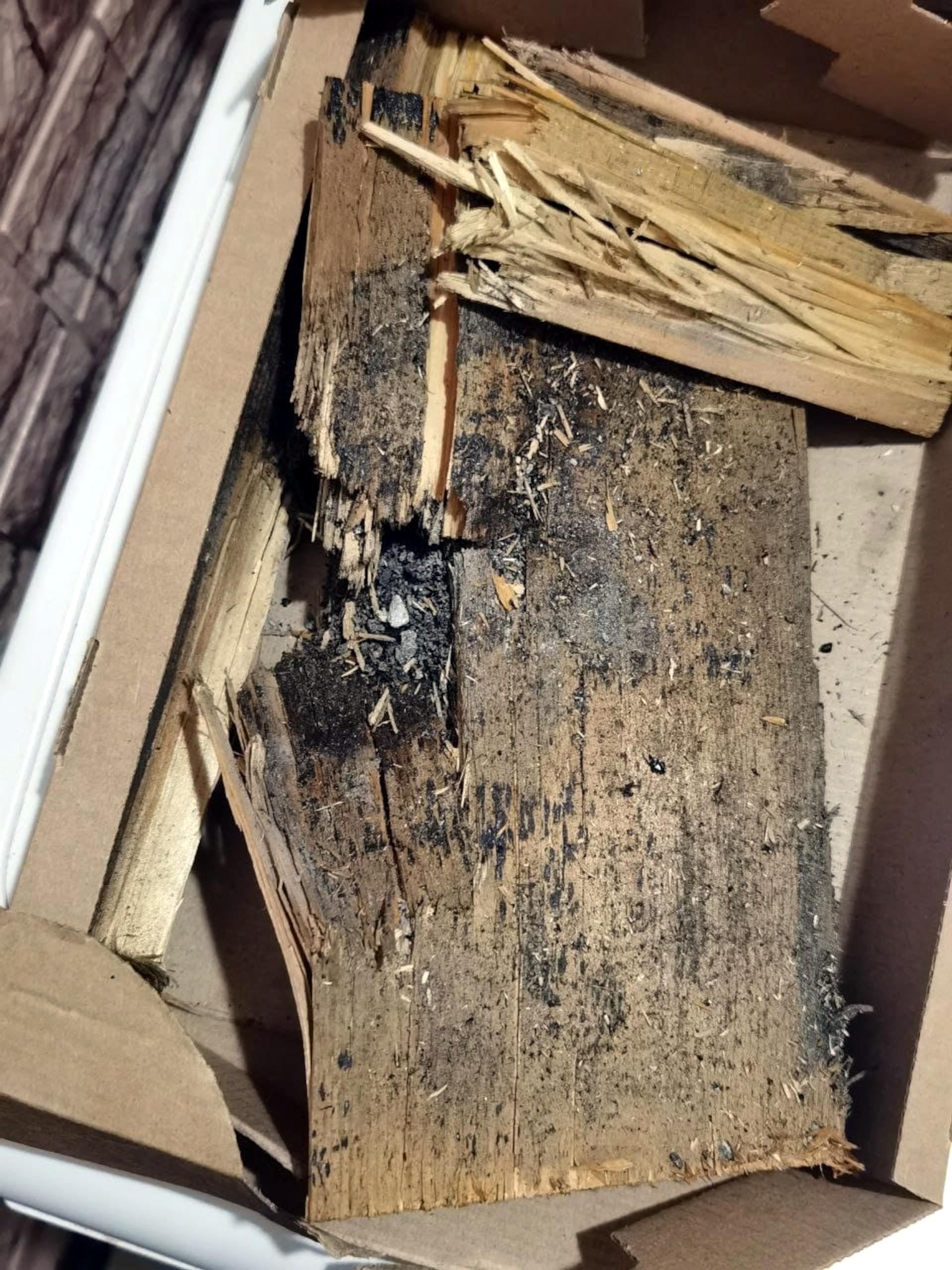
The cut-out pierced wooden roof beam. Photo: Konstantin Ryazantsev
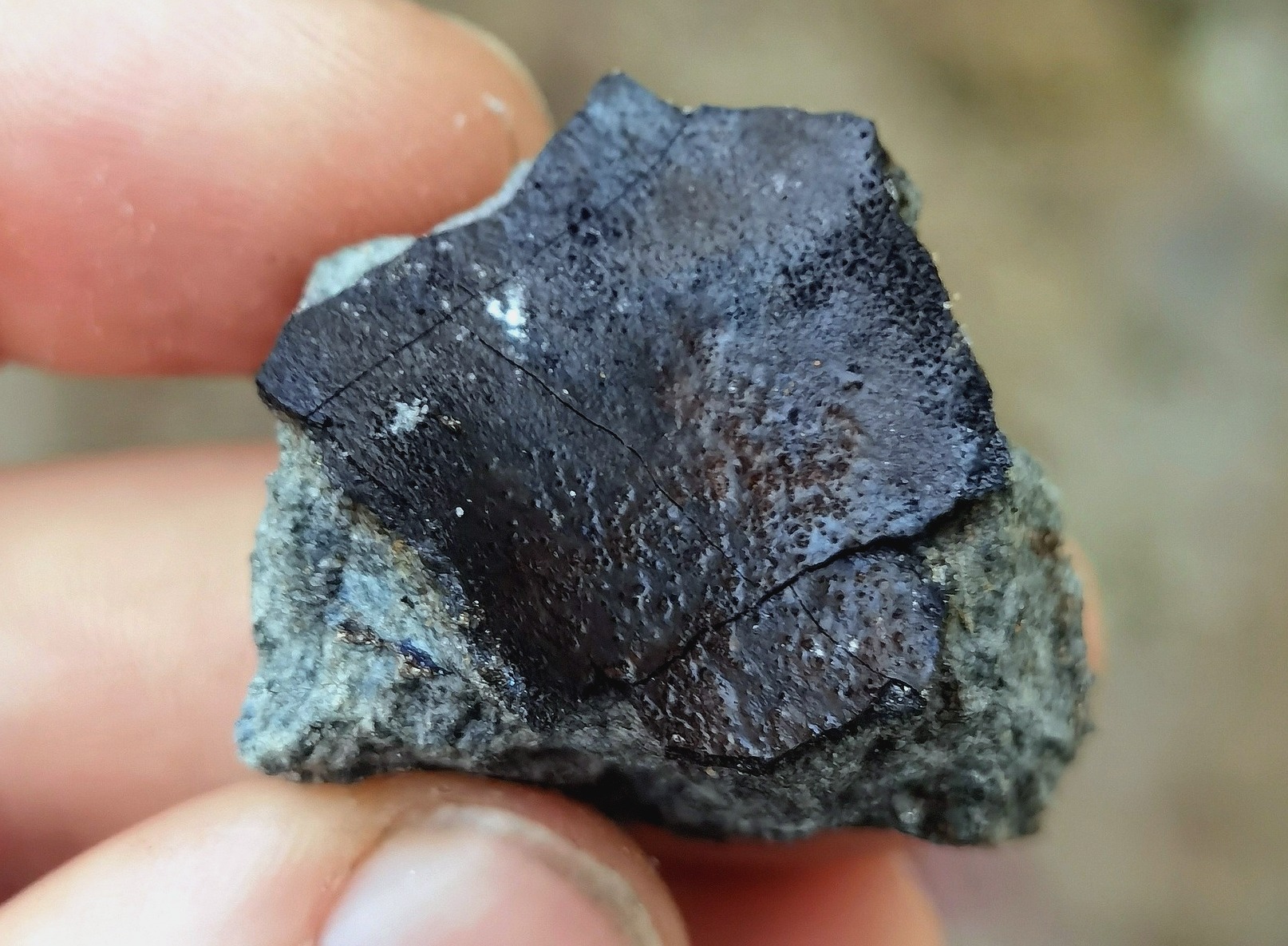
Photo: Konstantin Ryazantsev
Inspecting the impact site on the roof and cutting out the impact hole
Video: Konstantin Ryazantsev (13 November 2025)
Video: Konstantin Ryazantsev (13 November 2025)
Video: Konstantin Ryazantsev (13 November 2025)
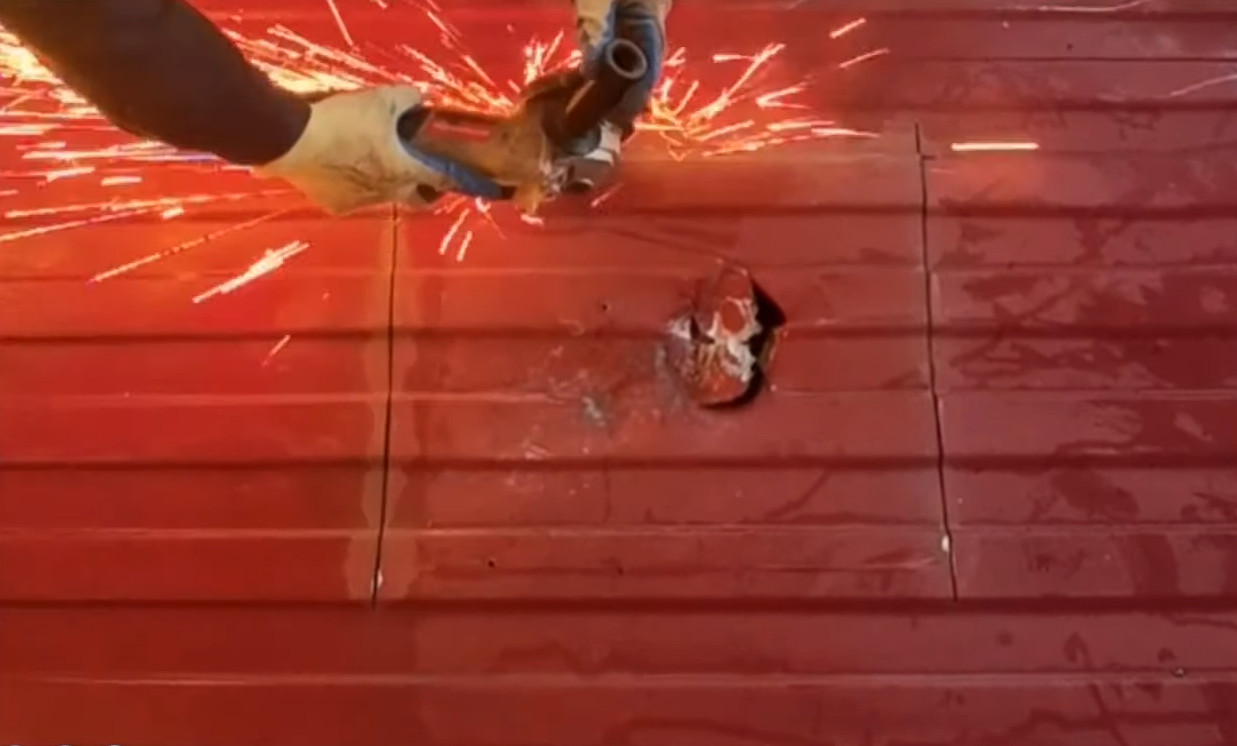
Cutting the impact dent out of the roof panel. Photo: ГЕОХИ РАН (20 November 2025)
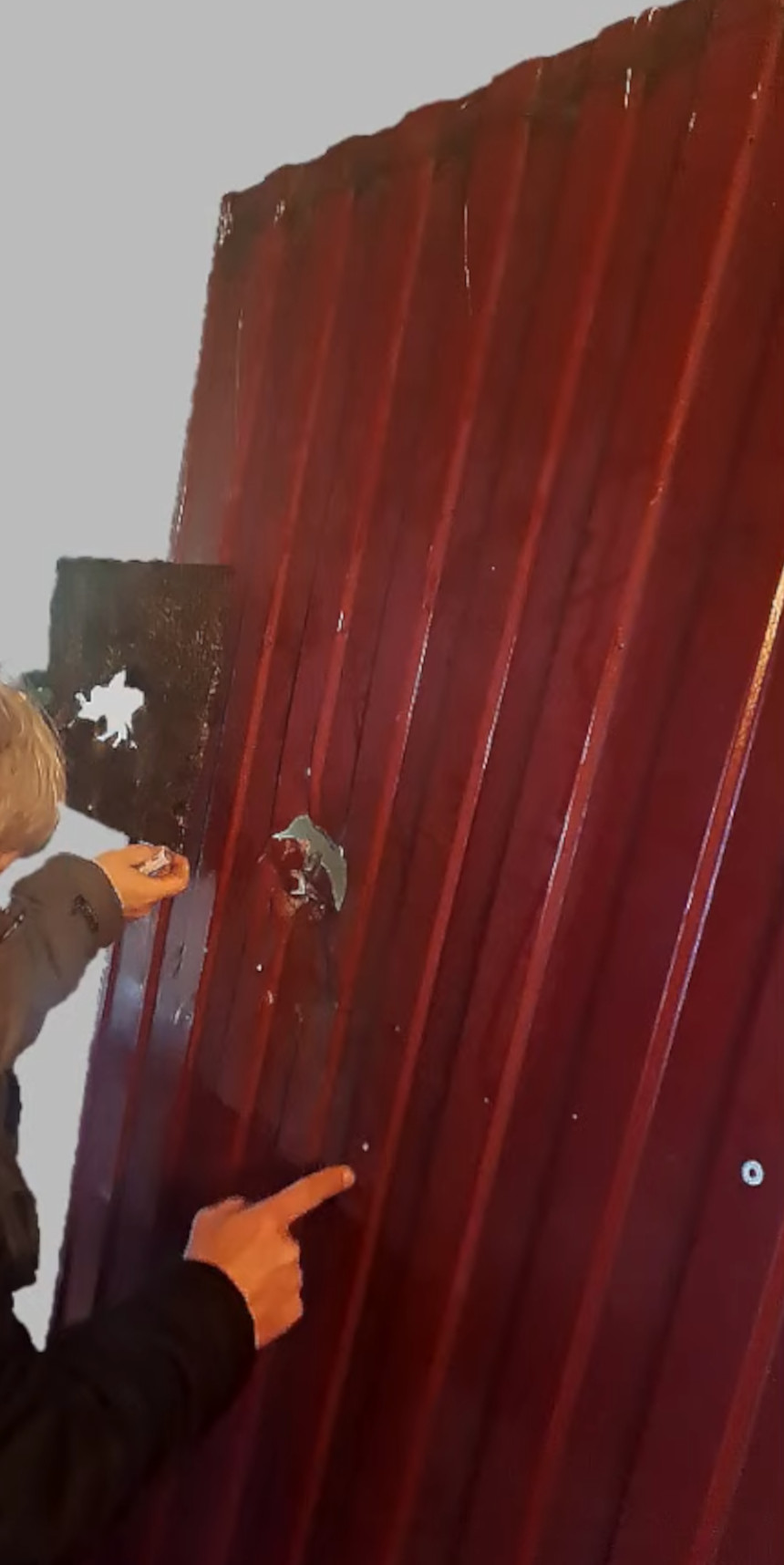
Konstantin Ryazantsev and Dmitry Sadilenko inspecting the removed roof panel before cutting out the impact dent. Photo: Photo: ГЕОХИ РАН (20 November 2025)
Meteorite exhibition in the Museum of the History of the Universe/Музей Истории Мироздания
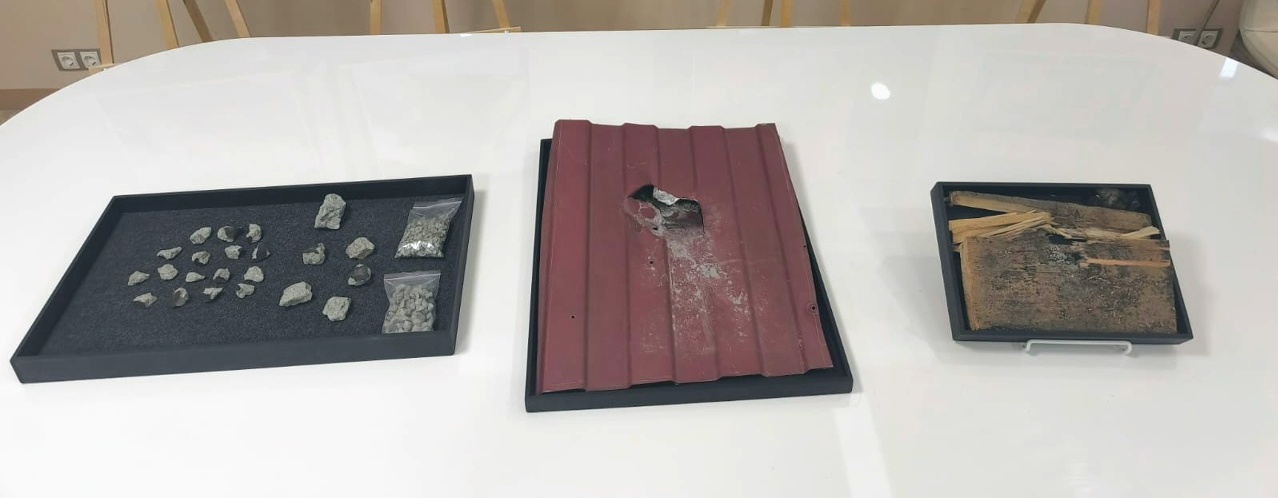
Meteorite fragments, the cut-out section of the roof panel, the cut-outpierced wooden roof beam and a thin section of the meteorite which can be viewed on a microscope display are exhibited the Museum of the History of the Universe. Photo: Музей Истории Мироздания

Photo: Музей Истории Мироздания
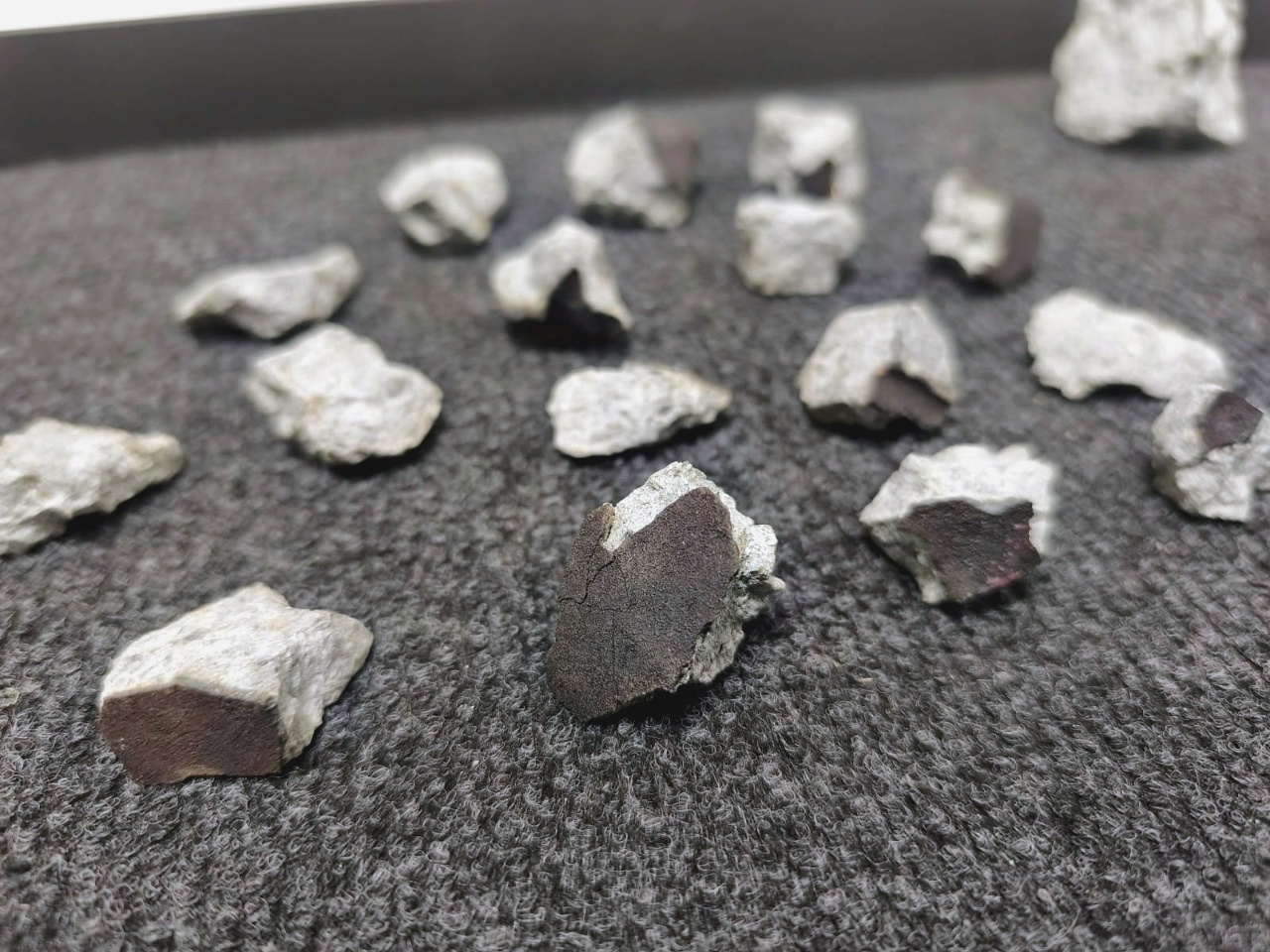
Photo: Музей Истории Мироздания
The 31-second shallow-angled bolide
Flight attendant Alexandra Spasskaya filmed the bolide from the plane SU 1289. Video: sasha_bashnya_
Bolide recorded from Moscow. Video: unknown
Bolide recorded from Moscow. Video: unknown
Bolide recorded from Popovo in Yaroslavl Oblast. Video: Starvisor
Bolide recordings. Video: Starvisor | Night Sky Patrol project
Bolide recorded from Felisovo Village, Moscow Region, Mytishchi District, (cameras is facing north). Video: Evgeny Belyaev
Video: Ipixras
Video: unknown
MEDIA
A Novgorod regional TV (НТ) film crew in the field with Dmitry Sadilenko (published on 13 November 2025). Video: Novgorod regional TV
РЕН TV crew in the field with Evgeniy Trofimov (published on 12 November 2025). Video: РЕН TV
Some information on this page have kindly been provided by Evgeniy Trofimov. Thank you!