Fluid history in the ungrouped C2 Essebi meteorite parent bodyOPEN ACCESS
L.J. Riches, M.D. Suttle, I.A. Franchi, X. Zhao, M.M. Grady
Geochimica et Cosmochimica Acta
In Press, Journal Pre-proof, Available online 18 December 2025
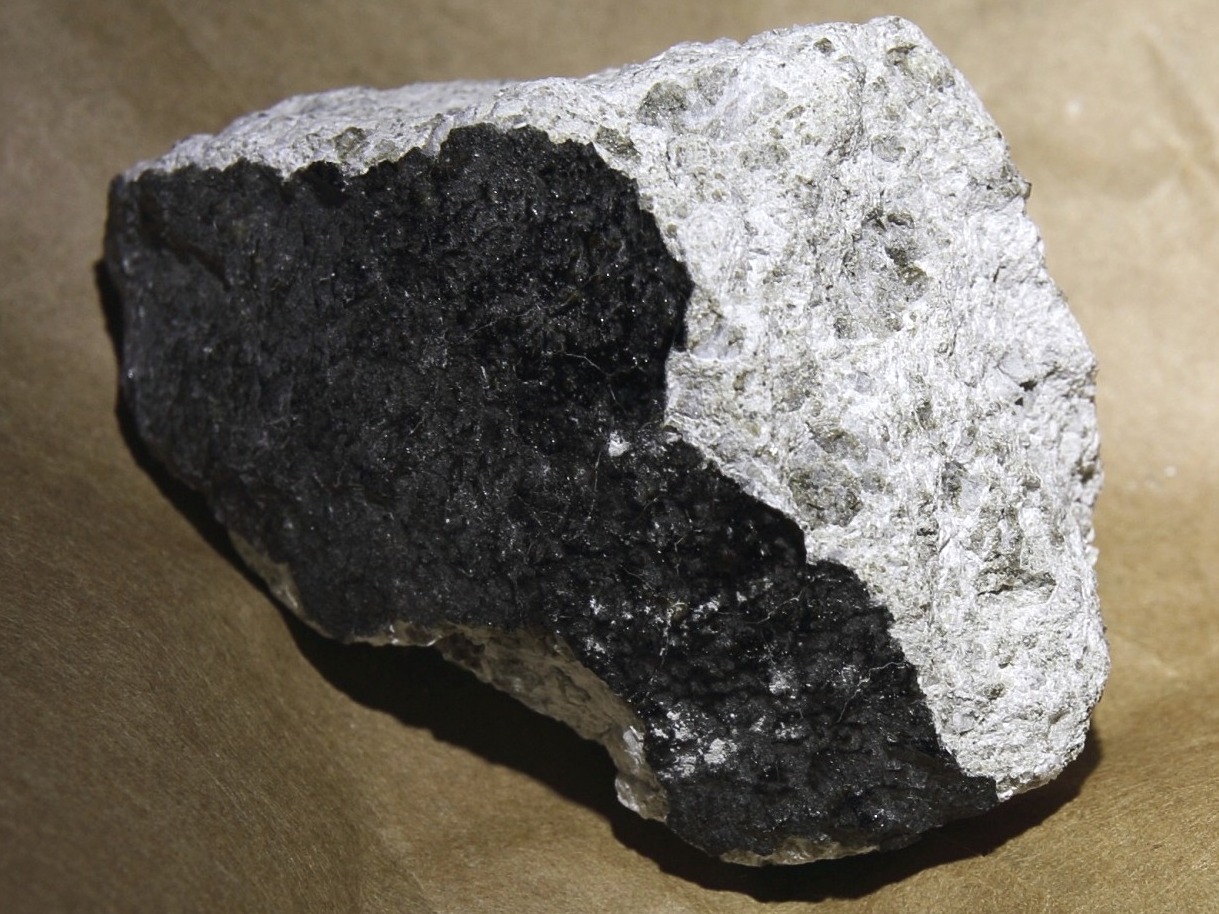
“Analysis of carbonate minerals in ungrouped carbonaceous chondrites offer valuable insights into the geological activity on a diverse range of early-formed, hydrated planetesimals in the outer Solar System. Essebi is a C2-ung chondrite, which originated from a water-rich asteroid with close affinities to the CM chondrites group. We performed a detailed geochemical, petrographic and isotopic study of Essebi. Modal mineralogy demonstrates that Essebi is dominated by a poorly crystalline, fine-grained phyllosilicate matrix (mostly a mix of saponite and serpentine ∼63 vol%) with a modest quantity of anhydrous silicates (20 vol%) and accessory magnetite (7.5 vol%), Fe-sulphides (5.5 vol%) and carbonates (2 vol%). Its bulk O-isotope composition (2.71 ‰ δ17O (± 0.018 1σ), 8.11 ‰ δ18O (± 0.002 1σ) and −1.53 ‰ Δ17O (± 0.017 1σ) and 2.56 ‰ δ17O (±0.040 1σ), 7.65 ‰ δ18O (±0.009 1σ) and −1.42 ‰ Δ17O (±0.039 1σ)) places Essebi as part of the “CM field”, although overlapping with the “CR field”. Petrographic observations reveal multiple generations of carbonate that formed both before and after brecciation, exhibiting distinct characteristics that differ from the carbonates found in established groups (CMs). Essebi’s carbonate generations have distinct morphologies and C- and O- isotope compositions and, based on these data, are interpreted as two main generations and a series of other localised carbonate expressions.
The first generation (GA) carbonates formed prior to phyllosilicate growth, and have inferred maximum formation temperatures of +41 °C. They formed under high water-to-rock (W/R) ratios. The second generation (GB) carbonates show lower W/R ratios and at higher, although unquantified temperatures. They formed near the end of the alteration sequence from a residual fluid containing abundant dissolved cations. In addition to the two main generations, we identified a third population of vein carbonates (GC) that partially infilled fractures generated by brecciation. We also identified dolomite (GD) grains found exclusively within an xenolithic clast. This clast displays a more advanced stage of alteration (C1-ung) and shows evidence of fluid leaching after being embedded, resulting in the formation of a localized ring of calcites, referred to as GE, that remain distinct from all other carbonates in this sample.
Despite textural differences, the isotopic trends observed in these Essebi carbonates closely resemble the sequence described by T1 and T2 calcites in CM chondrites, suggesting that multiple distinct episodes of carbonate precipitation, aqueous alteration along a prograde metasomatic sequence, and isotopic evolution from 16O-poor to 16O-rich trajectories were common across several water-rich planetesimals that formed in the outer Solar System.”