Lunar spinel-bearing troctolitic anorthosite NWA 12279 meteorite: Linking petrology, mineralogy and spectroscopyOPEN ACCESS
Hongyi Chen, Jiankai Zhou, Lanfang Xie, Jinyu Zhang, Zhipeng Xia
Icarus, In Press, Journal Pre-proof, Available online 4 November 2025
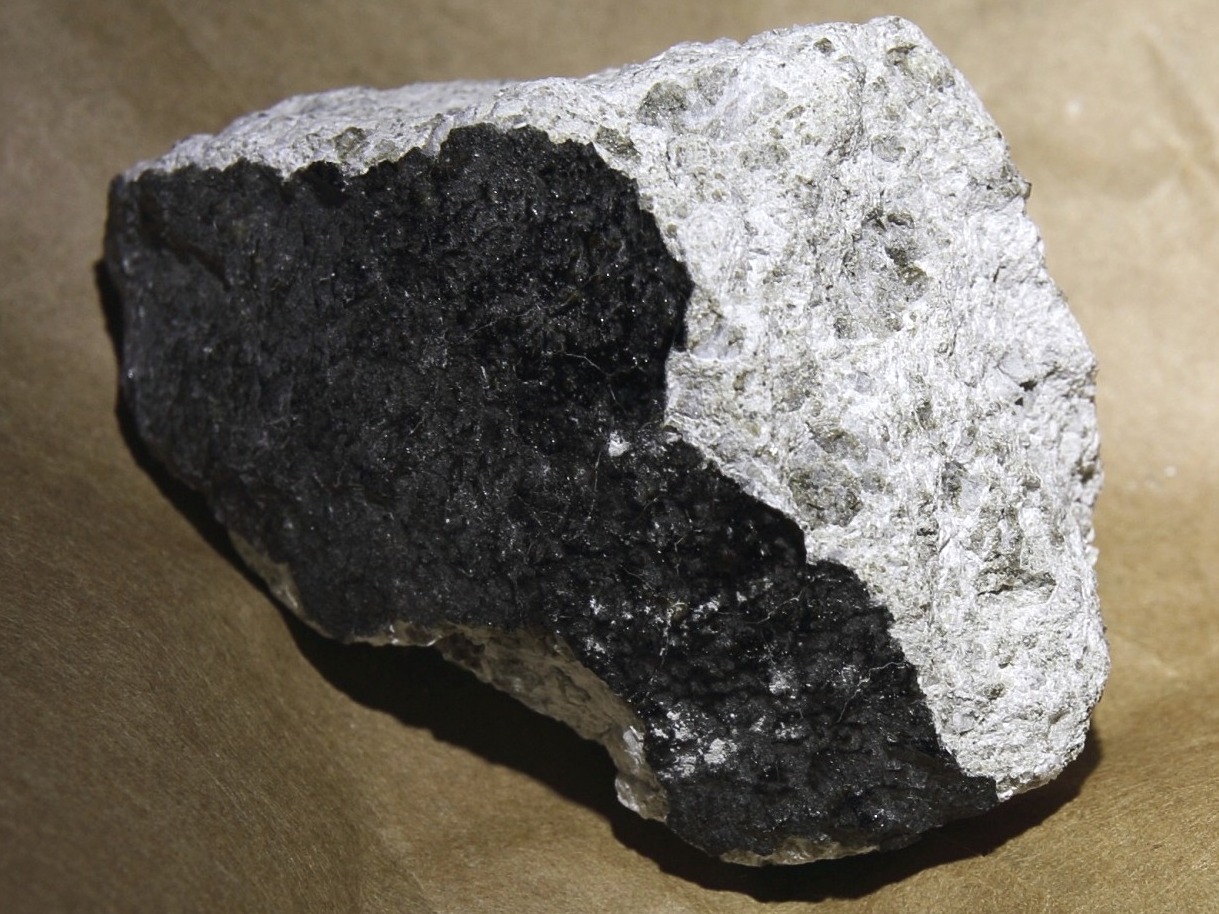
“The Mg-suite lithologies, particularly pink spinel-bearing rocks, provide critical insights into the Moon’s crust-mantle interactions and impact metamorphism. However, discrepancies persist between remote sensing interpretations and laboratory analyses regarding the petrological characteristics of pink spinel anorthosite (PSA) or pink spinel troctolite (PST). The unbrecciated lunar meteorite NWA 12279, identified as a pink spinel-bearing troctolitic anorthosite (PSTA), offers a pristine record with well-preserved igneous textures, minimal shock metamorphism (S1–S2), and low terrestrial weathering (W0–1) affecting its mafic minerals and spinels. Combined petrological, mineral chemical, Visible-Near Infrared (VNIR) spectroscopy, and Raman spectroscopic analyses reveal a homogeneous composition dominated by anorthite (81.8 ± 0.1 vol%, An = ~97.2), olivine (11.7 ± 1.3 vol%, Fo = ~76.8), augite-dominated pyroxene (4.75 ± 0.45 vol%, En = ~57.4), and Mg-spinel (0.96 ± 0.48 vol%, Mg# = ~82.4). Reflectance spectra from six selected profiles across the sample section show diagnostic absorptions at 1050 nm (olivine), 1950 nm (Mg-spinel), and 2300–2350 nm (high-Ca pyroxene), with spectral contrasts that correlate directly with the spatial distribution of spinel. Regions enriched in spinel display a notably stronger absorption depth at 1950 nm. Furthermore, we establish well-defined linear correlations (R2 ≥ 0.971) under low-shock conditions (<4 GPa) that enable robust in-situ composition prediction. These quantitative models—olivine Fo from Peak A (~820 cm−1; y = 3.050× – 2430), spinel Mg# from Peak B (~670 cm−1; y = 0.0461× + 50.82), and pyroxene En from Peaks C (~661 cm−1; y = 2.635× – 1701.5) and D (~1007 cm−1; y = 2.547× – 2522.4). These quantitative models help resolve orbital detection discrepancies for Mg-spinel-rich lithologies and provide essential ground truth for lunar mineralogy. Our findings demonstrate that even modest Mg-spinel abundances of ~1.0 vol% can produce detectable spectral signatures, challenging existing genetic models for lunar crustal evolution. This study underscores the value of Raman spectroscopy for future lunar missions and indicates a need to recalibrate orbital interpretations of Mg-suite lithologies.”