Grokhovskyite, CuCrS2, a New Chromium Disulfide in Uakit Iron Meteorite (IIAB), Buryatia, RussiaOPEN ACCESS
Victor V. Sharygin, Grigoriy A. Yakovlev, Yurii V. Seryotkin, Nikolai S. Karmanov, Konstantin A. Novoselov and Maxim S. Karabanalov
Minerals 2025, 15(12), 1295, Published: 11 December 2025
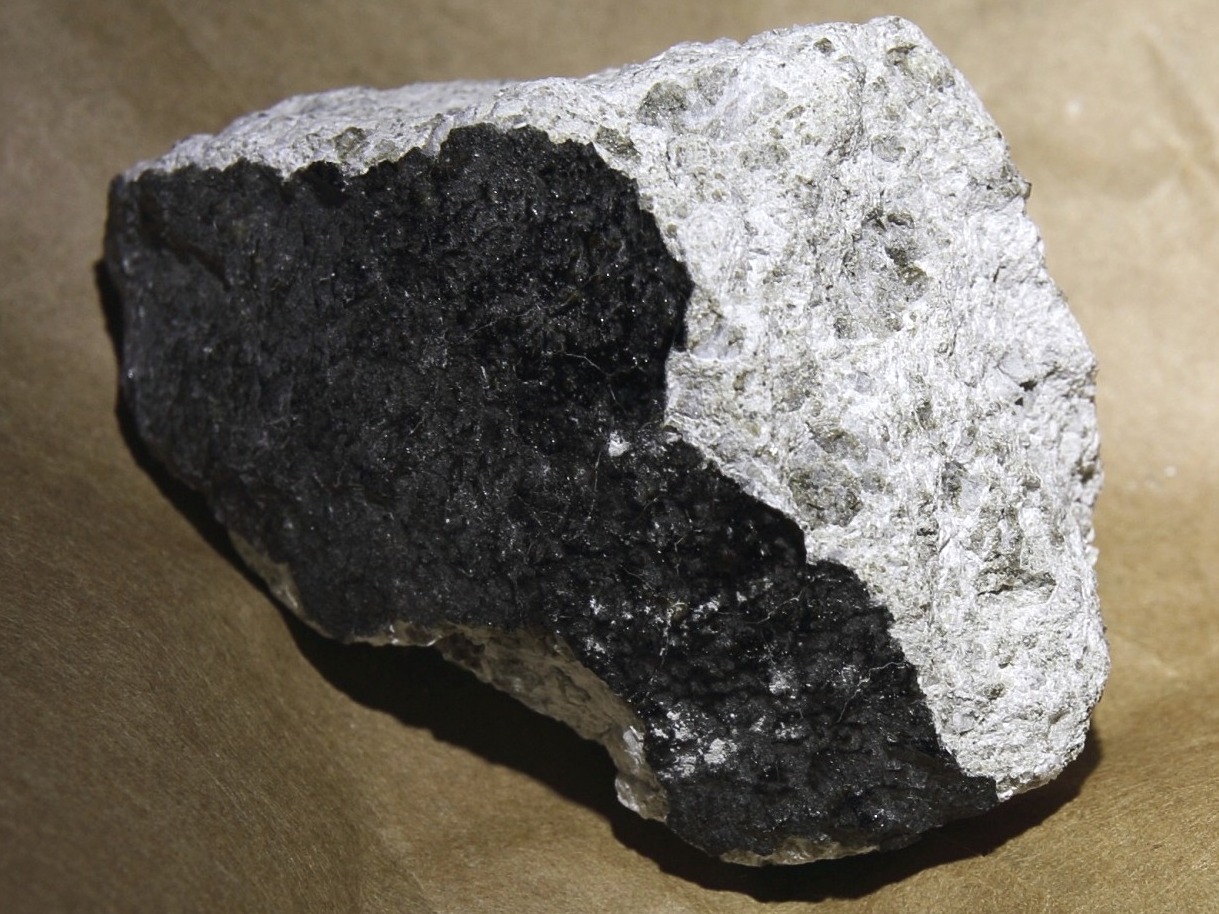
“Grokhovskyite, CuCrS2, was observed in small sulfide inclusions (up to 50–80 µm) in Ni-rich iron (kamacite) of the Uakit iron meteorite (IIAB) in the Republic of Buryatia, Russia. The grain sizes of this mineral are usually less than 5 μm, and the biggest detected crystals are 10 × 5 μm in size. It is commonly associated with daubréelite, troilite, schreibersite, and, sometimes, with carlsbergite and uakitite. Within inclusions, the mineral forms elongated splintered crystals, or, rarely, needle-shaped grains in daubréelite. The grokhovskyite-containing associations in the Uakit meteorite seem to form due to high-temperature (>1000 °C) separation of Fe-Cr sulfide liquid, which is locally enriched in Cu, from Fe-Ni metal melt. Physical and optical properties of grokhovskyite are quite similar to those of synthetic CuCrS2: yellow–brown and non-transparent phase with metallic luster; Mohs hardness ≈ 4; gray to light gray color with yellow tint in reflected light; weak to medium bireflectance, anisotropy, and pleochroism; density (calc.) = 4.559 g/cm3. Grokhovskyite is structurally related to the Cr-containing disulfide minerals with general formula Me+CrS2 (where Me+ = Na, Cu, Ag), including caswellsilverite, NaCrS2; schöllhornite, Na0.3CrS2·H2O; and cronusite, Ca0.2CrS2·2H2O. Structural data were obtained for one grokhovskyite crystal using the EBSD technique. Fitting of the EBSD patterns for a synthetic α-CuCrS2 model (trigonal R3m; a = 3.4794(8) Å; c = 18.702(4) Å; V = 196.08(10) Å3; Z = 3) resulted in the parameter MAD = 0.57–1.16° (good fit). Analytical data for grokhovskyite (n = 36, in wt.%) are as follows: Cu—32.97; Cr—27.65; Fe—3.69; Ni—0.16; S—35.71; Na, Zn, V, Mn, and Co—below detection limit (<0.005 wt.%). The empirical formula is (Cu0.930Cr0.952Fe0.118Ni0.005)2.005S1.995; however, different concentrations of Fe are indicated in two individual grains of grokhovskyite (0.09–0.17 apfu). Such variations may be explained by Fe incorporation in the grokhovskyite structure according to the scheme IVCu+ + VICr3+ → IVFe2+ + VIFe2+. The three main bands (near 110, 250, and 310 cm−1), which are common of synthetic CuCrS2, were observed in the Raman spectra of grokhovskyite.”