Correlative Microstructural Analysis of a Weathered Nantan Meteorite FragmentOPEN ACCESS
Graeme J. Francolini, Brendan V. Dyck, Paul Mack, Ben Britton
Preprint submitted to Elsevier
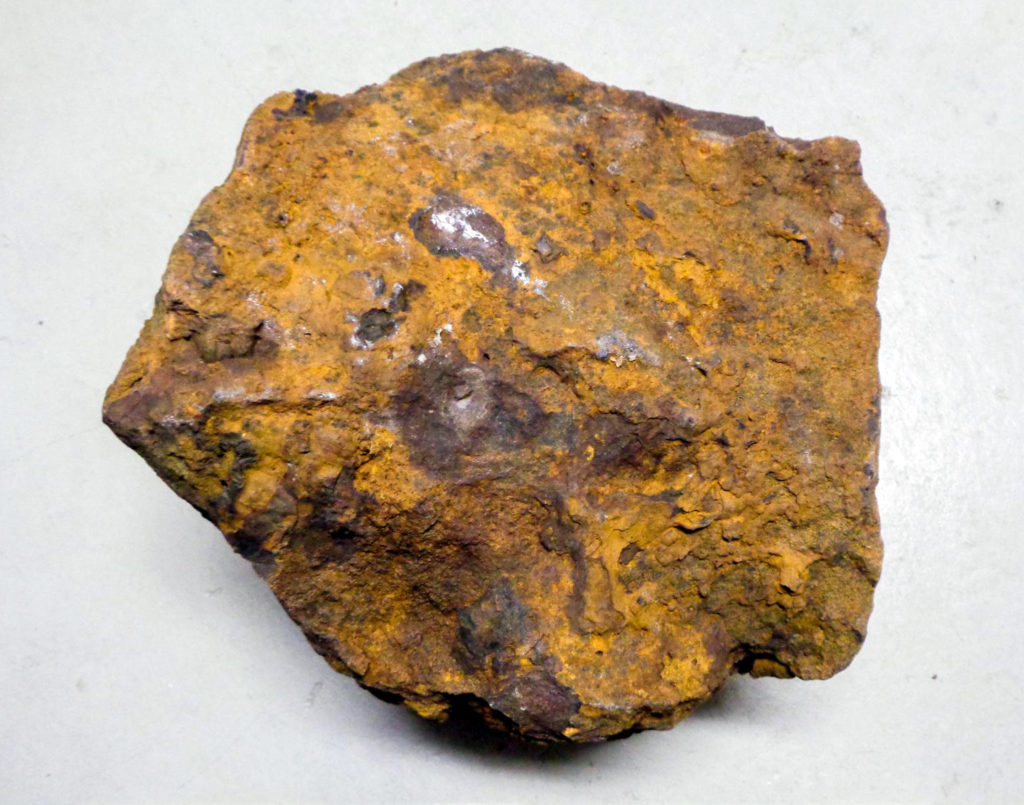
“The weathering of iron-rich phases within meteorites is a multi-stage process that significantly alters the microstructure and chemical composition based both on the environmental condition at the location of landing and the exposure time since the fall. This work investigates the resulting phases of this process in a correlative and comparative manner using a naturally weathered Nantan meteorite fragment. Techniques including X-ray Photoelectron Spectroscopy, Energy Dispersive X-ray Spectroscopy, and X-ray Fluorescence Spectroscopy were used for compositional determination and X-ray Diffraction and Electron Backscatter Diffraction for phase determination and microstructural analysis. Use of these techniques revealed the meteorite matrix to be predominantly composed of magnetite, with distinct regions of high Ni content. The grain structure was found to be very fine (approx. 5 μm) in areas of high Ni (≥2.6 at%) content with a visible boundary of 100-200 μm extending into the low Ni (≤0.9 at%) regions, wherein the grains averaged 10s of 𝜇m in size. Other common products of weathering, including goethite, lepidocrocite, and feroxyhyte, were also found within the matrix alongside Ni(OH)$_2$. Additionally, a brecciated phase was found within the sample and appeared to be a large cohenite grain which exhibits signs of aqueous weathering, including in a vein-like structure, composed of NiO and magnetite, and deposits of iron and nickel carbonates. These results indicate that the distinct matrix regions formed through the weathering mechanism of discrete primary phases, with the high Ni regions forming from aqueous alteration of kamacite and the low Ni regions forming from direct dissolution and oxidation of the source Fe-Ni metal.”