Ultrarefractory inclusion from the H3 ordinary chondrite Chug Chug 072
Konstantin M. Ryazantsev , Marina A. Ivanova, Alexander N. Krot, Kazu Nagashima, Cyril A. Lorenz, Vasiliy D. Shcherbakov
Geochemistry, Available online 26 October 2026
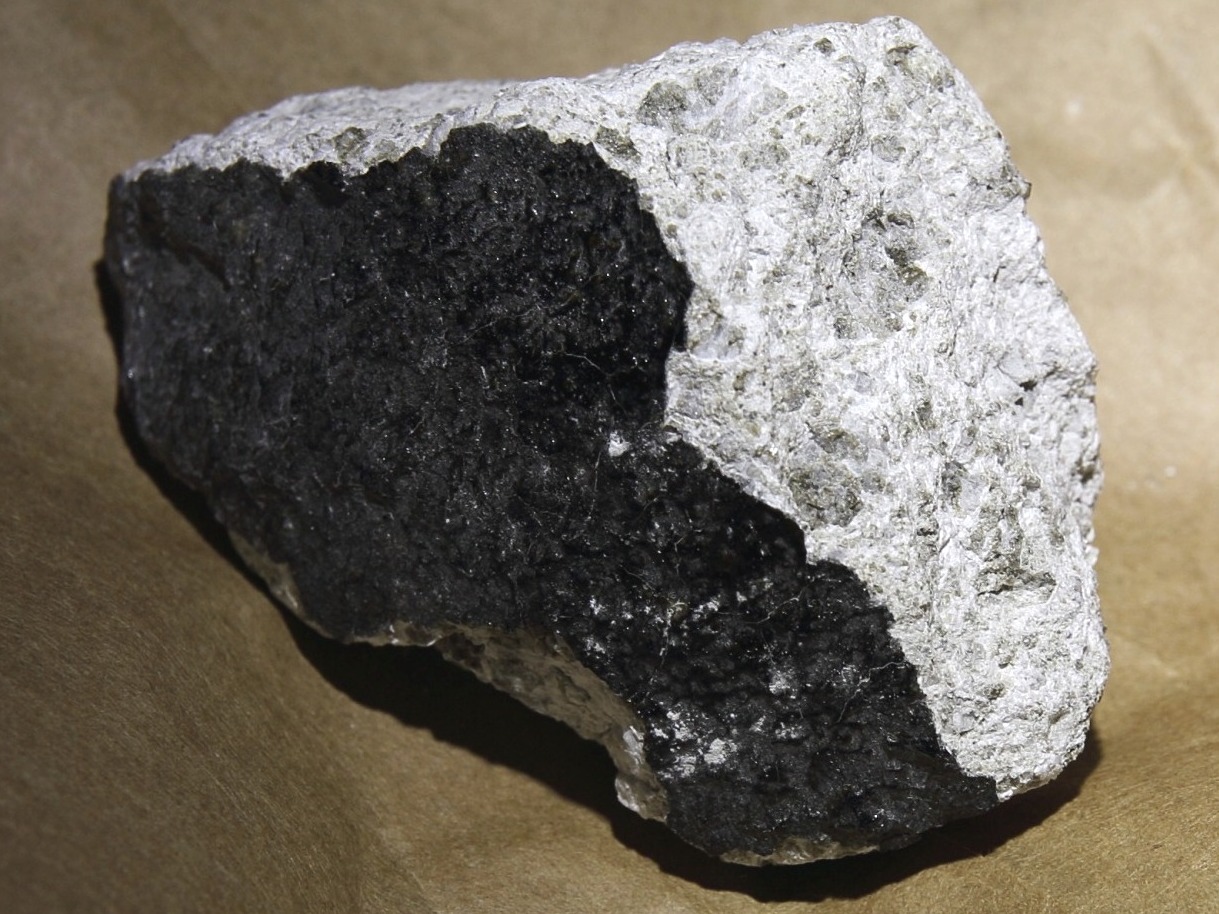
“We describe an ultrarefractory Ca,Al-rich inclusion (UR CAI) CC072–1 in the ordinary H3 chondrite Chug Chug 072 (CC 072), which is a polymict microbrecia containing carbonaceous chondrite clasts. CC072–1 consists of several mineralogically-zoned nodules. The cores of nodules, composed of perovskite, warkite, and kangite, are surrounded by mantles of Sc-rich davisite and spinel. The texture and mineralogical zoning of CC072–1 suggest it formed by gas-solid condensation in a cooling nebular gas. Most primary minerals of CC072–1 are enriched in FeO, indicative of metasomatic alteration and thermal metamorphism in an asteroidal setting. The CAI is isotopically heterogeneous: spinel is 16O-rich (Δ17O ~ −23 ‰, where Δ17O = δ17O – 0.52 × δ18O), whereas warkite, perovskite, and davisite are 16O-depleted to various degrees (Δ17O ranges from ~ −18 to −3 ‰). We concluded that CC072–1 likely originated in a 16O-rich gas of approximately solar composition, and subsequently experienced post-crystallization O-isotope exchange with an aqueous fluid. Since Δ17O of aqueous fluid in type 3 ordinary chondrites inferred from Δ17O of secondary magnetite and fayalite is ~ +5 ‰, significantly higher than the Δ17O of 16O-depleted minerals in CC072–1, the oxygen-isotope exchange experienced by CC072–1 could have occurred prior to its incorporation into the CC072 parent asteroid, possibly in a CM-like chondrite parent body. Following the migration, accretion and low-velocity impact event the UR CAI was incorporated in the H3 chondrite during brecciation.”