Metamorphism and aqueous alteration of the unusual carbonaceous chondrite Northwest Africa 4757
Marina A. Ivanova, Maria G. Krzhizhanovskaya, Sergey N. Britvin
Geochemistry, available online 31 July 2025, 126319
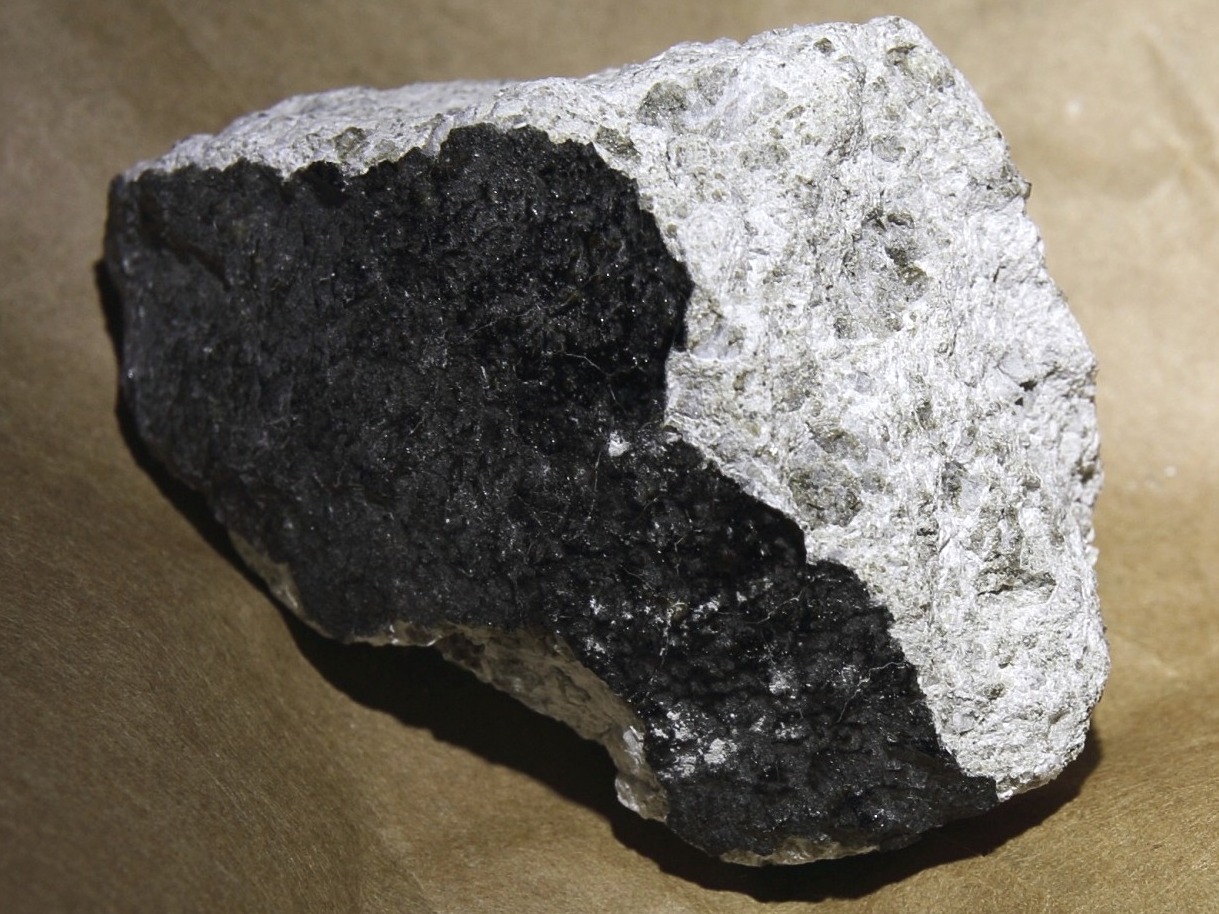
“The first CY chondrite from the Northwest Africa region was studied (NWA 4757). It is a small (5 g) fine-grained monomict microbreccia consisting of abundant matrix (~95 vol%) and rare pseudomorphic chondrules (up to 200 μm). The meteorite has main characteristics of CY chondrites. The oxygen isotopic composition of NWA 4757 is 16O-poor (δ18O = 23.83, δ17O = 12.84, Δ17O = 0.45 to δ18O = 26.96, δ17O = 14.50, Δ17O = 0.48 ± 0.03) which is the heaviest among other CY chondrites. NWA 4757 contains abundant sulfides (~20 vol%) and its bulk chemical composition is enriched in sulfur compared to CM chondrites like most other CY chondrites except for Dhofar 225 and Dhofar 735.
NWA 4747 was affected by very intensive aqueous alteration corresponding to petrologic type 1.0 before it was affected by thermal metamorphism. Only a few grains of unaltered olivine (Fa10) survived in NWA 4757. In contrast to other CYs, troilite from NWA 4757 are Mn-rich. The matrix is divided into light and dark types in texture and composition. The light matrix is Ca-rich, and Fe-poor compared to the dark matrix. The dehydrated phyllosilicates had serpentine composition with a low saponite content like CY2s. The presence of high-Ni metal and sulfides, chromite and ilmenite and absence of magnetite indicate that under equilibrium conditions, the redox state of the alteration system in the NWA 4757 parent body did not exceed the fugacity of the iron-wustite buffer.
After aqueous alteration NWA 4757 experienced intensive thermal metamorphism resulting in a low H2O (1.9 wt%) compared to usual CI and CM chondrites. The Fourier Transform Infrared (FT-IR) spectroscopy of the matrices of NWA 4757 and Mighei (CM2) showed that the NWA 4757 matrix is dominated by Fe-rich fine-grained olivine. According to a classification system for thermally metamorphosed hydrated carbonaceous chondrites based on X-ray Powder Diffraction (XRD) data, NWA 4757 is characterized by heating stage IV (>750 °C) like CY2s. Since calcite (and even dolomite) survived metamorphism, it should indicate that the peak temperature was not higher than 800 °C. Thus, NWA 4757 is the first CY chondrite of thermal stage IV (CY2) which had properties of extremely altered CM1 chondrite before metamorphism and suggestively should be CY2-m1.”