Exploring methods for identifying iron meteorites on the surface of Mars from orbit
M.C. Rudin, R.C. Wiens, B. Horgan, N.L. Lanza, N.L. Lanza, M. Hoffman, C. Schröder
Icarus, In Press, Journal Pre-proof, Available online 22 May 2026
“Highlights
- Meteorites on Mars are unevenly distributed and not contextualized.
- Iron meteorites are not distinguishable from orbit using high-resolution images.
- Results inform on required spectral capabilities for orbital missions to Mars.”
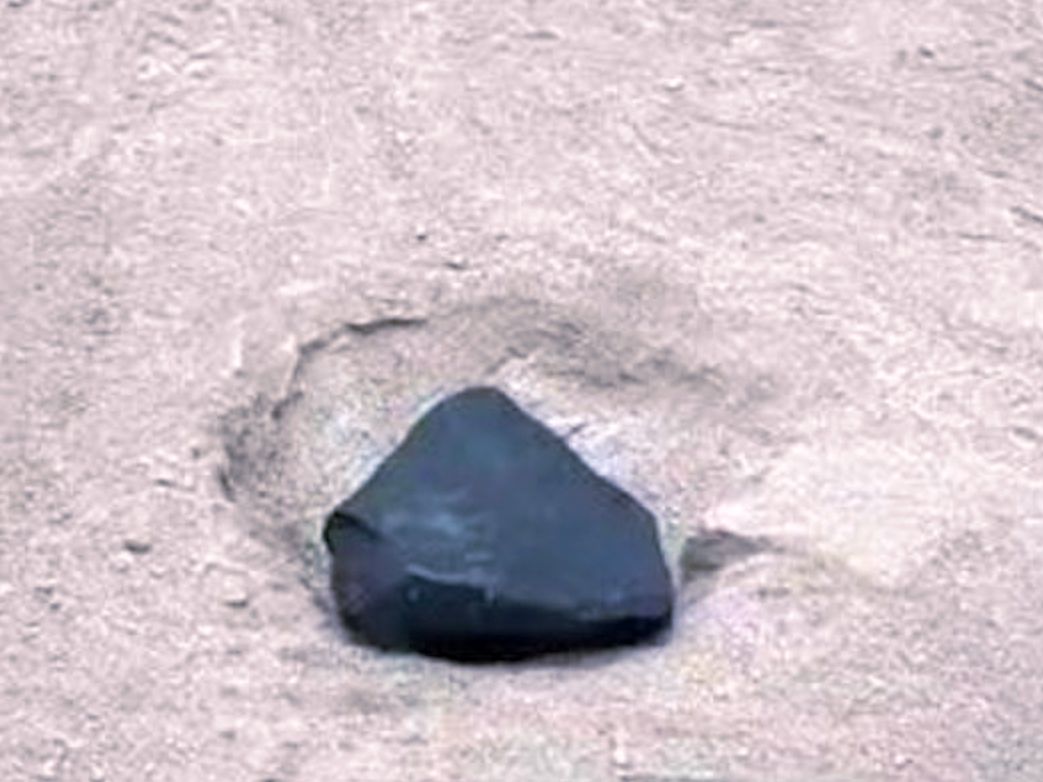
“Meteorites have been found at Mars Exploration Rover landing sites and by the Curiosity rover at Gale Crater. However, only two possible meteorites have been found at Jezero Crater by the Perseverance rover to date, which implies an uneven surface distribution. If meteorite distribution and location is quantified broadly, this context would provide insight into past surface processes responsible for the transport, burial, degradation, and emplacement of meteorites on the Martian surface. Because meteorite detection is currently limited by rover location, it is necessary to explore techniques to observe, map, and quantify their distribution. In this work, we attempt to distinguish iron meteorites with meter-size dimensions from orbit using their spectral properties. Using color data from the High-Resolution Imaging Science Experiment (HIRISE), we compare five known iron meteorites found by the Curiosity rover to other features from orbit. We find that iron meteorites are not sufficiently unique compared to dark regolith and other boulders over large regions of the Martian surface to make confident identifications using HiRISE alone.”