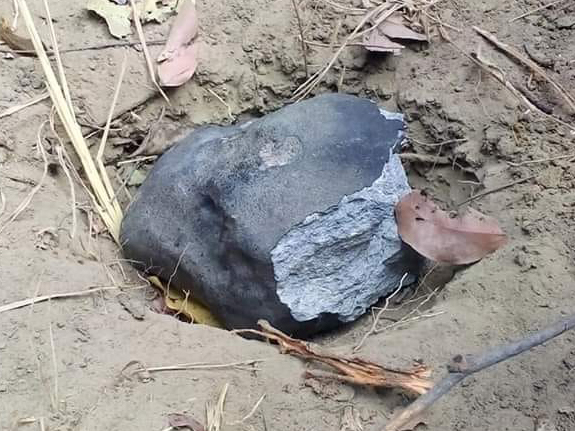
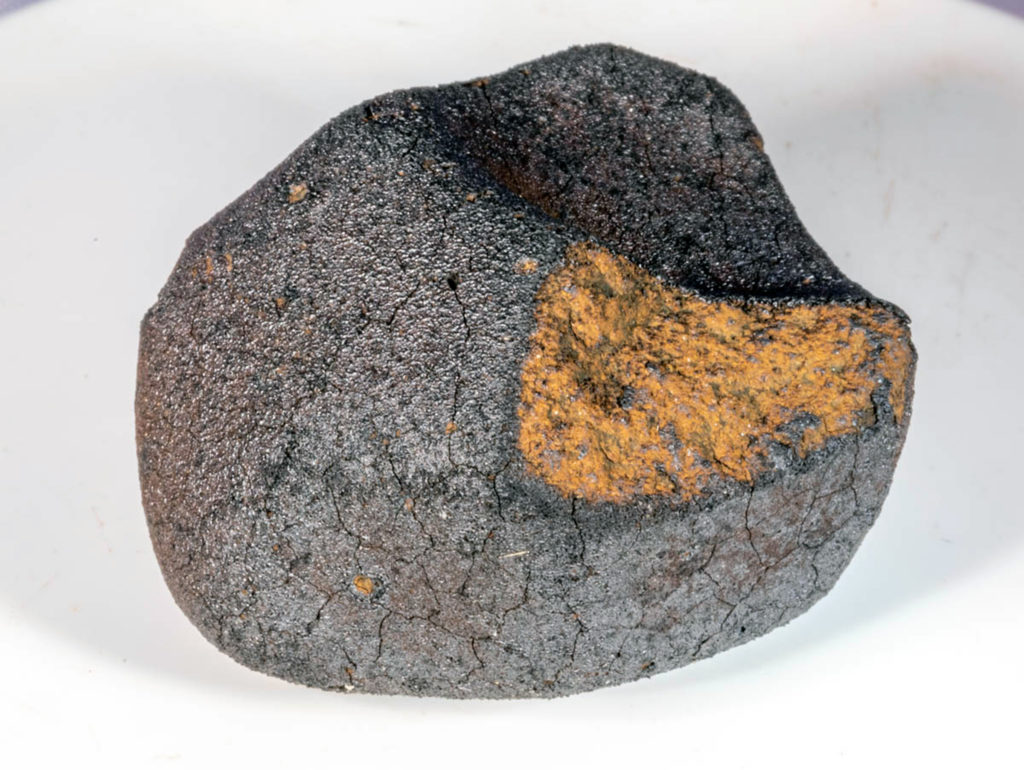
Presolar stardust in the ungrouped chondrite Chwichiya 002
Lucas R. Smith, Pierre Haenecour, Jessica J. Barnes, Kenneth Domanik, Mason Neuman, Kun Wang, Piers Koefoed, Elias Bloch, Ryan Ogliore
MAPS, Version of Record online: 04 June 2026
“We performed an in-depth study of the mineralogy, petrology, chemical composition, and presolar grain abundance of the C3.00-ungrouped chondrite Chwichiya 002 using a combination of in situ and bulk analytical methods. Chwichiya 002’s bulk composition is significantly enriched compared to CI chondrites (over 20 × CI for Sr, Ba, U) in rare earth and trace elements like Li, Sr, Ba, U, and Pb, indicating effects of terrestrial weathering. Concentrations of Ti and Al are similar to CI chondrites, but notably depleted relative to other carbonaceous chondrite groupings, suggesting that the parent body of Chwichiya 002 accreted from a source with a near CI composition of refractory elements, and with a low quantity of calcium–aluminum-rich inclusions. A slight reduction in Fe is linked to the predominance of FeO-poor chondrules and olivine, likely a remnant of Chwichiya 002’s formation history. Our findings uncovered phyllosilicates in the matrix and combinations of tochilinite–cronstedtite, confirming that Chwichiya 002 underwent more extensive alteration on its parent body than previously believed. We identified 12 O-anomalous presolar grains (8 Group 1, 4 Group 4) and nine presolar SiC grains, with abundances of 12.1 + 4.6/−3.5 ppm for O-rich grains and 7.8 + 3.6/−2.6 ppm for SiC grains. The relatively low occurrence of O-rich presolar grains is similar to what is seen in CM2 chondrites and samples from asteroid 162173 Ryugu, despite Chwichiya 002 being classified as type 3.00 petrologically. We conclude that Chwichiya 002 formed from a refractory-poor source similar to CM and CO chondrites, primarily consisting of FeO-poor chondrules and olivine, and underwent a moderate level of aqueous alteration on its parent body. Furthermore, the mineralogy, petrology, and compositional data reported in this study, combined with previous data on the O-isotopes of Chwichiya 002, suggest that the sample may better be classified as a CM2.8 or CM 2.9 chondrite.”