New knowledge about shock events that affected the L-chondrite parent body from two heavily shocked L6 meteorite findsOPEN ACCESS
I. Baziotis, L. Ferrière, C. Ma, J. Hu, D. Palles, P. D. Asimow
MAPS, Version of Record online: 06 October 2025
LINK (OPEN ACCESS)
PDF (OPEN ACCESS)
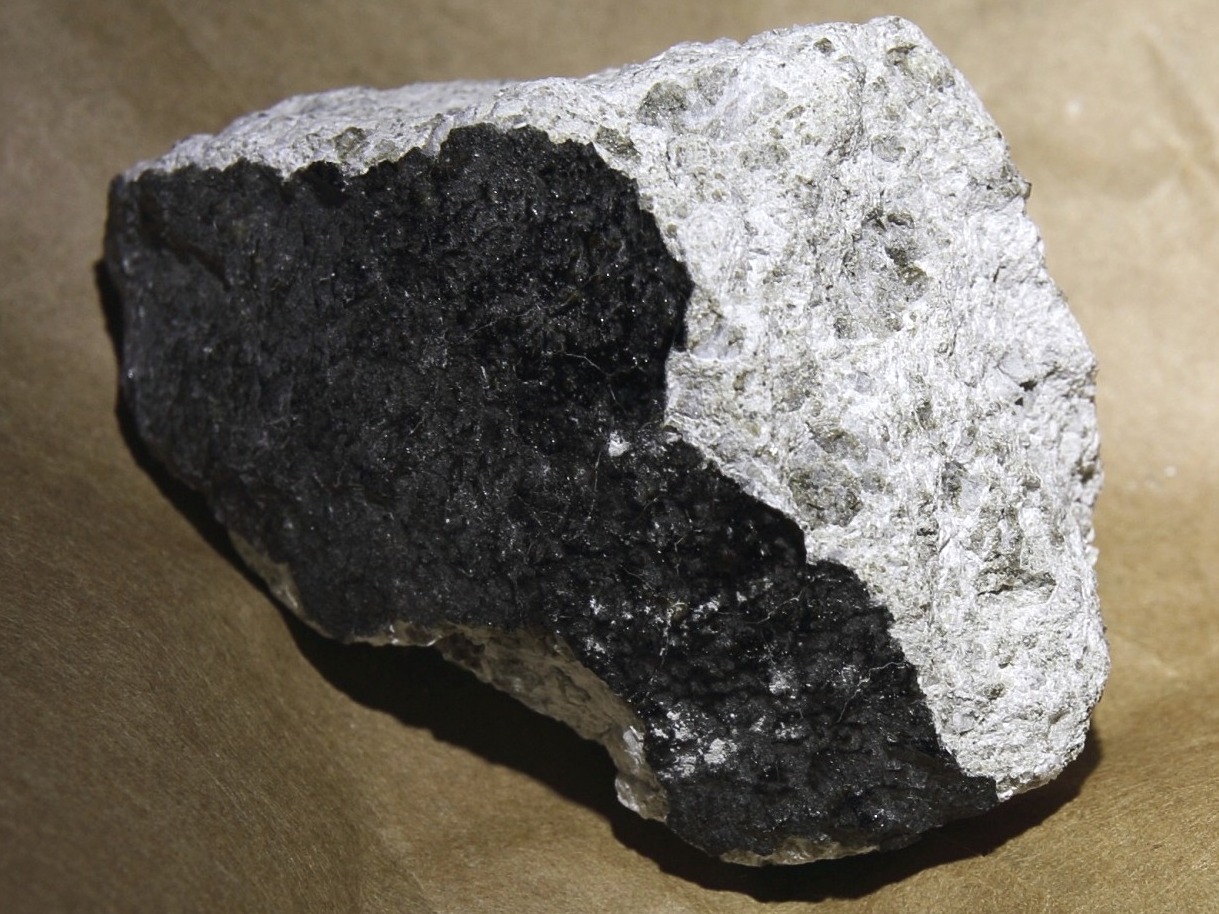
“We report new results from a study of shock-related features in the L6 ordinary chondrites Northwest Africa (NWA) 4672 and NWA 12841. Our observations confirm the occurrence of eight high-pressure (HP) minerals in each meteorite, namely, ringwoodite, majorite, akimotoite, wadsleyite, albitic jadeite, lingunite, tuite, and xieite. Based on the calibration of phase stability fields and majorite chemical variations from static experiments, we estimate peak shock conditions of 18–23 GPa and 1800–2100°C. However, both meteorites also contain minerals thought to record lower pressures, 14–18 GPa for wadsleyite, and possibly ~11.5 GPa for albitic jadeite. These are interpreted to have formed by cooling during partial release from the peak shock state. Although the presence of discrete shock melt veins demands spatial heterogeneity in the temperature field, we interpret the record of HP mineralogy in terms of temporal rather than spatial variation in pressure–temperature conditions during the shock and release event. Specifically, we infer that the cooling of shock melt veins to their liquidus occurred near peak pressure, whereas decompression began before the melt veins reached their solidus. NWA 4672 and NWA 12841 also display dense networks of shock melt veins, metal–sulfide segregations, and dark shock zones, implying a high density of pre-existing weak zones and, thus, a high likelihood of fragmentation during atmospheric entry. A comparison with the Suizhou L6 chondrite, in which a total of 26 HP phases have been identified, suggests that differences in the identification and number of observed HP polymorphs mostly reflect differences in the completeness and spatial scale of analytical studies rather than a true difference in the intensity of shock processing. It remains quite likely that many shocked L chondrites host more HP phases than have been recognized so far. These new results indicate a need for further high-resolution studies of L chondrites to distinguish between observational bias and true variations in the range of shock states they experienced.”